The UK’s large SUV market, a fiercely contested arena dominated by established European and Asian titans, is notoriously difficult to penetrate. It demands a blend of practicality, prestige, technological prowess, and a finely tuned driving experience. Into this gauntlet steps a new contender, not with a cautious knock, but with a confident stride. The Omoda 9, arriving on British shores in June 2025, is more than just another SUV; it is the flagship of a calculated and ambitious global strategy, a vehicle designed to challenge conventions and reset expectations of what a sub-£50,000 family vehicle can deliver. But as it squares up against household names, the critical question remains: does this newcomer have the substance to back up its undeniable style? This in-depth analysis will dissect every facet of the Omoda 9, from its game-changing powertrain to its global market ambitions, to determine its true place in the UK’s automotive landscape.
A New Contender on UK Roads: Introducing the Omoda 9
To understand the Omoda 9 is to understand its origins. This is not the product of a fledgling startup but the sharp end of a spear wielded by an industrial giant. Its arrival signals a new phase in the global expansion of one of China’s most formidable automotive players.
The Chery Connection: More Than Just a New Badge
The Omoda brand is the creation of Chery Automobile, one of China’s largest and most established vehicle manufacturers and a dominant force in automotive exports. Rather than simply exporting Chery-branded vehicles, the parent company has developed a sophisticated multi-brand strategy for international markets, creating distinct identities to target specific consumer tastes. Omoda, founded in 2023 alongside its sibling brand Jaecoo, is positioned as the “sportier,” more design-led of the two, while Jaecoo focuses on a more rugged, off-road aesthetic. This deliberate segmentation reveals a deep understanding of global market nuances and underscores that the Omoda 9 is the product of a well-funded, strategically planned venture, not a speculative experiment.
First Impressions: Design and Road Presence
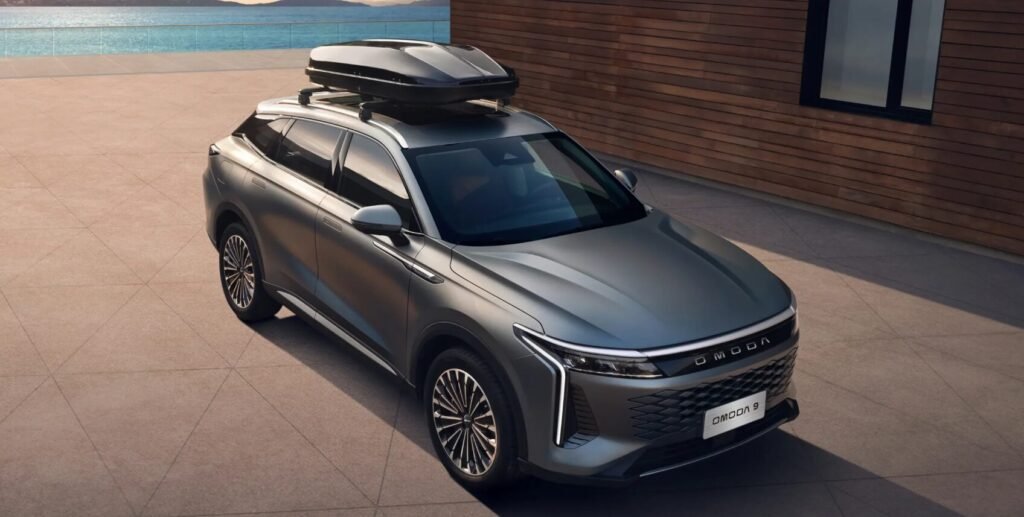
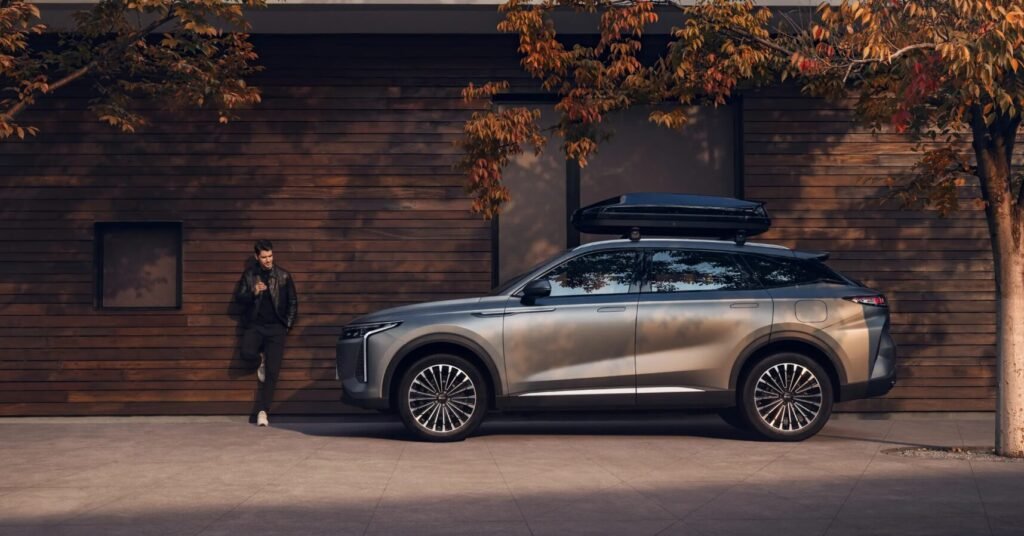
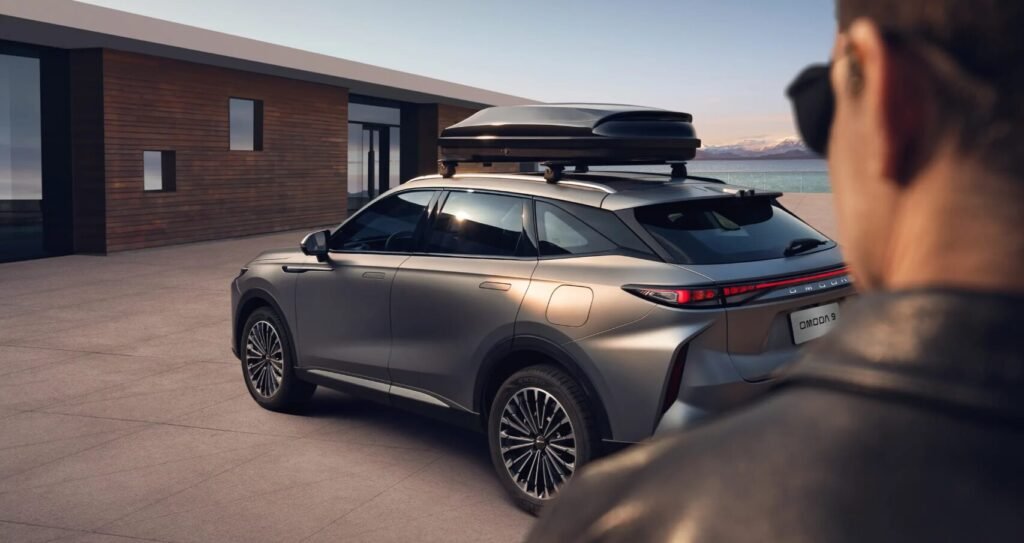
The Omoda 9 makes an immediate and powerful visual statement. With dimensions of 4,775 mm in length, 1,920 mm in width, and 1,670 mm in height, it firmly plants itself in the large SUV segment, comparable in size to a Kia Sorento or Skoda Kodiaq. The design language is bold and aspirational, clearly aiming to compete with more premium offerings like the Range Rover Velar and BMW X5.
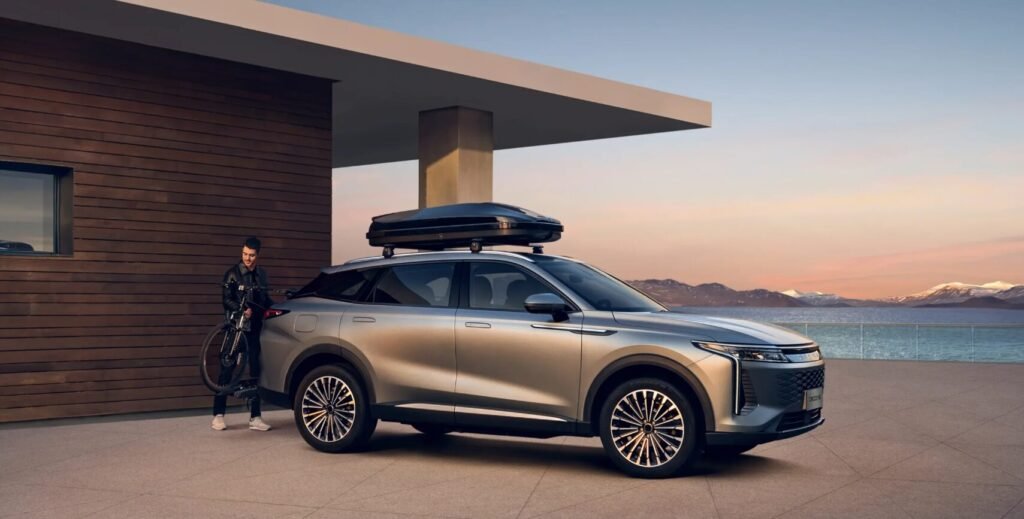
The front is dominated by a large grille with a complex diamond-style motif, a signature shared with its smaller Omoda 5 sibling. However, the 9 distinguishes itself with a unique lighting signature composed of 134 individual LEDs that form a continuous line between the headlights and down the sides of the front end. This system performs a ten-second “welcome dance” upon unlocking the car, a piece of theatre designed to create a sense of occasion. The side profile is clean, with a swooping roofline and muscular bulges over the rear wheels, while the rear features a now-common full-width light bar connecting the tail lamps.
The UK Launch: Pricing, Trims, and Market Positioning
The first Omoda 9s are set to reach UK customers in June 2025. The brand has adopted a strikingly simple pricing structure for its flagship model. It will be offered in a single, high-end trim level called “Noble,” with a starting On-The-Road (OTR) price of £44,990. This reflects an “everything-as-standard” philosophy, with the only significant optional extra being the exterior paint colour. While standard Quartz White carries no charge, metallic finishes such as Andesite Grey, Onyx Black, or Peridot Green add £750, and a semi-matte Hawk’s Eye Grey costs £1,000.
This pricing is a critical component of its market strategy. By crossing the £40,000 threshold, the Omoda 9 is subject to the UK government’s “expensive car supplement,” which increases the annual Vehicle Excise Duty (road tax) for years two through six of ownership. This means that for the majority of buyers who opt for a metallic paint, the effective price will be closer to £46,000, a figure that places it in direct competition with well-equipped versions of established rivals.
This single, high-specification trim level is a calculated “value-shock” tactic. Established premium manufacturers, particularly from Germany, have long operated on a model of advertising an attractive base price for a sparsely equipped vehicle, compelling customers to spend thousands of pounds on optional packages to achieve a desirable specification. Omoda has inverted this model. By presenting one fully-loaded trim, they offer a transparent, final price that, while seemingly high for a new brand, represents exceptional value when compared to a similarly equipped competitor from BMW or Audi. This approach simplifies the purchasing process, eliminates the frustration of complex options lists, and creates a clear marketing message: “a large, luxury SUV priced like a midsize one”. It is, however, a high-risk strategy. If the vehicle’s quality and driving experience fail to live up to the promise of its spec sheet, the absence of a cheaper, lower-tier model provides no safety net to attract more budget-conscious buyers.
Under the Bonnet: A Game-Changing Plug-in Hybrid Powertrain
While the Omoda 9’s design is intended to capture attention, its powertrain is engineered to capture the market. The Super Hybrid System (SHS) is not merely an incremental improvement on existing plug-in hybrid technology; it represents a significant leap forward that redefines the capabilities and use-case for this type of vehicle.
The Super Hybrid System (SHS) Explained
At the heart of the Omoda 9 is a sophisticated plug-in hybrid (PHEV) powertrain. It combines a 1.5-litre turbocharged four-cylinder petrol engine with a pair of electric motors, managed by a three-speed Dedicated Hybrid Transmission (DHT). The combined system output is staggering for a vehicle in this class, producing between 443 and 449 horsepower. Torque figures are equally immense, with reports citing between 516 lb-ft and 915 Nm, depending on the measurement standard. This prodigious power propels the all-wheel-drive SUV from 0-62mph in a mere 4.9 seconds, a time that embarrasses not only its direct family SUV rivals but also many dedicated performance cars.
The 93-Mile Question: Redefining Electric Range
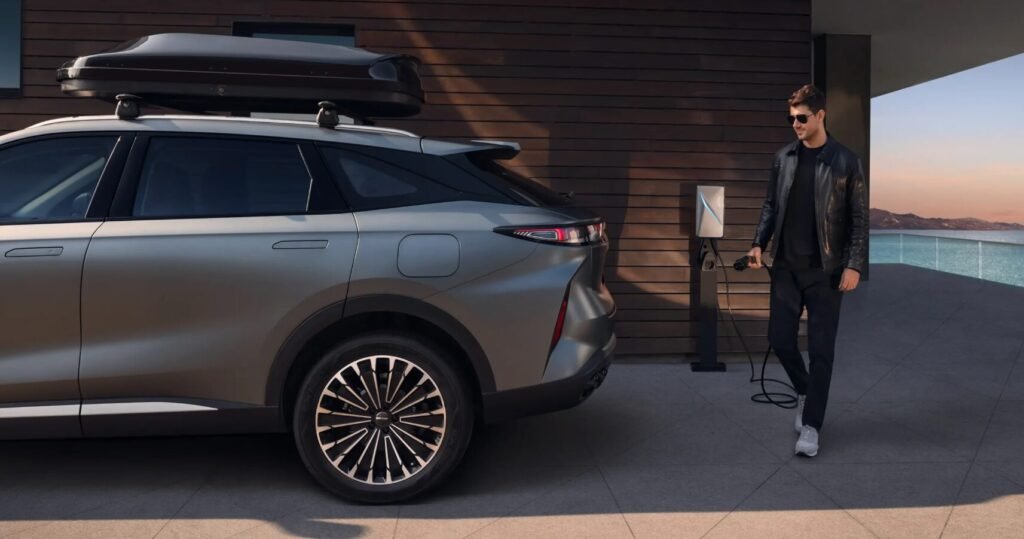
The headline feature of the SHS is its class-leading all-electric range. Thanks to an unusually large 34.5kWh battery pack, the Omoda 9 has an official WLTP-rated electric-only range of 93 miles. This figure is transformative for the PHEV segment. It is more than double the electric range offered by most competitors, including the Hyundai Santa Fe PHEV and Kia Sportage PHEV. To put it in perspective, the Omoda 9’s battery is larger than the one found in some first-generation, fully electric city cars like the Dacia Spring. This substantial range means that for a vast majority of UK drivers, the Omoda 9 can operate as a pure electric vehicle for all daily commuting and errands, potentially going days or even weeks without needing to use the petrol engine.
Charging Ahead: The 70kW DC Rapid-Charging Advantage
Further cementing its technological lead, the Omoda 9 comes equipped with 70kW DC rapid charging capability, a feature almost unheard of in the plug-in hybrid world. Most PHEVs are limited to slower AC charging, which can take several hours to replenish even their smaller batteries. The Omoda 9’s inclusion of a CCS port for DC charging allows it to achieve a 30-80% battery top-up in just
25 minutes. This fundamentally alters the vehicle’s usability on long journeys. A driver could travel from London towards Manchester, make a short coffee stop at a motorway service station, and add a significant amount of electric range, drastically reducing petrol consumption over the entire trip. This is a level of convenience and efficiency previously exclusive to fully electric vehicles.
Real-World Efficiency: Beyond the Brochure
The advanced powertrain delivers impressive real-world fuel economy. Independent UK tests have consistently recorded figures of around 47-48 mpg on mixed driving routes, even when the journey requires the petrol engine to run. The system is designed to operate primarily on electric power, with the petrol engine often acting as a generator to maintain a baseline level of charge in the battery rather than driving the wheels directly. This intelligent energy management ensures that even when the initial 93-mile electric range is depleted, the car continues to operate efficiently as a full hybrid. The combination of a full battery and a 70-litre fuel tank gives the Omoda 9 a claimed total theoretical range of over 700 miles.
The specifications of this powertrain effectively reposition the PHEV concept. Traditionally, PHEVs have been seen as a compromise, hampered by limited electric ranges that are often insufficient for a full day’s driving and slow charging speeds that make them reliant on petrol for anything beyond short trips. The Omoda 9 transcends these limitations. Its 93-mile range covers the average UK daily commute multiple times over, allowing it to function as a true EV for the majority of its life. The addition of DC fast charging provides a practical solution for reducing petrol use on the occasional long-distance journey. In doing so, it offers a near-EV daily experience without the primary drawback that still concerns many consumers about pure EVs: range and charging anxiety on long trips. This makes the Omoda 9 a powerful “bridge” technology, offering a compelling pathway for buyers who are intrigued by electrification but not yet ready to commit to a battery-only vehicle.
Step Inside: A Cabin of Space, Luxury, and Contention
If the powertrain represents the Omoda 9’s engineering prowess, the interior is where it showcases its ambition to compete in a premium space. The cabin is a study in contrasts, blending impressive features and a high-quality static feel with significant flaws in usability and dynamic refinement that emerge once on the move.
A Premium Ambience: Design and Materials
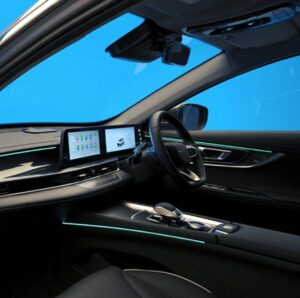
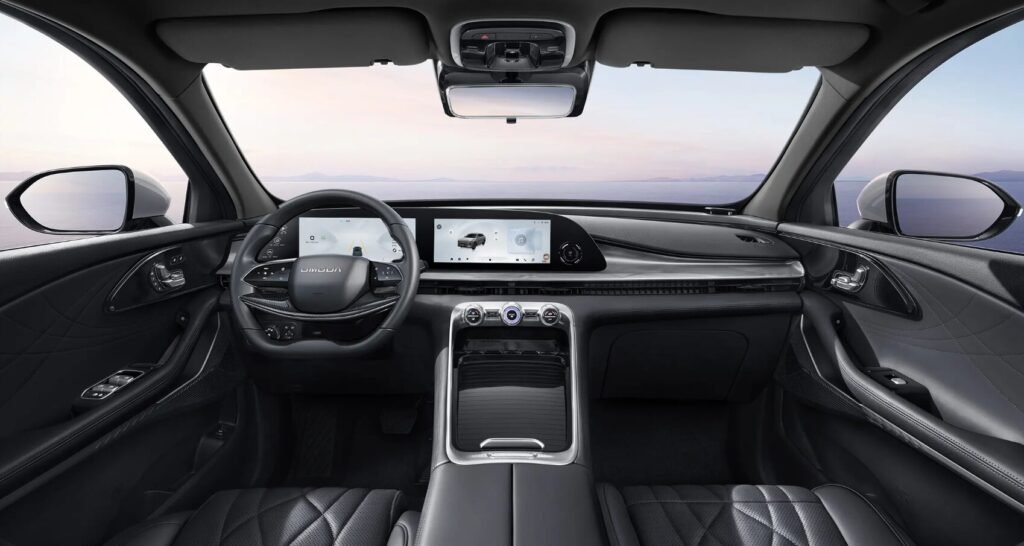
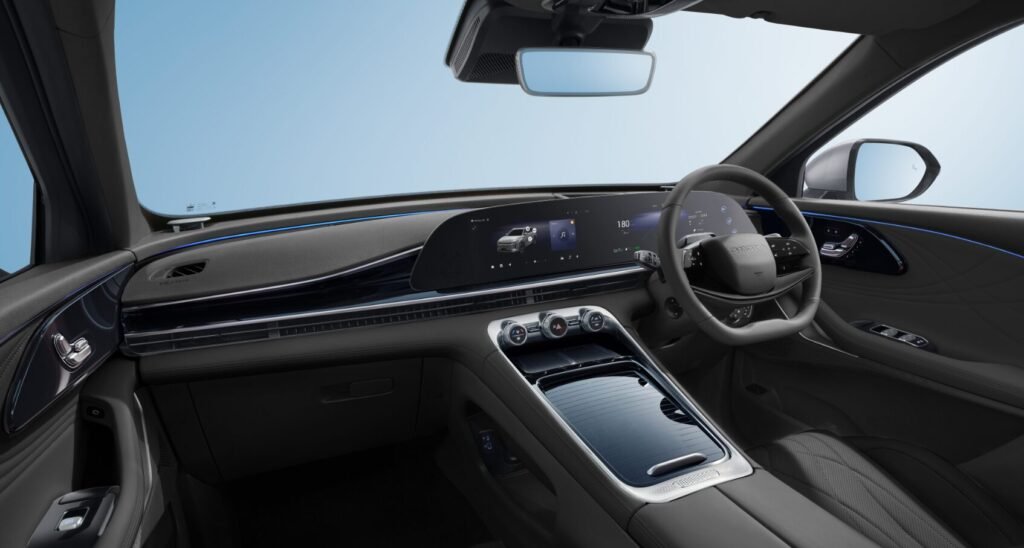
The interior design aims for a sophisticated, minimalist aesthetic, with a clear focus on creating a sense of space and technological luxury. The dashboard is dominated by a single, sweeping curved panel that houses two screens, creating a
24.6-inch digital expanse for the driver’s instruments and the central infotainment system. The material quality is a notable step up from what might be expected at this price point. There are plenty of soft-touch plastics, stitched leather on the seats and doors, and an overall solid feel to the construction. However, it stops short of true luxury. Closer inspection reveals that some controls with a metallic appearance are plastic, and the overall tactile quality of the switchgear, while perfectly acceptable, doesn’t match the premium feel of a Mercedes-Benz or Lexus.
The “Noble” Trim: An Exhaustive List of Standard Kit
The “everything-as-standard” approach of the single Noble trim means the Omoda 9 comes loaded with a remarkable array of features that are typically costly options on rival vehicles. The standard equipment list is exhaustive and includes :
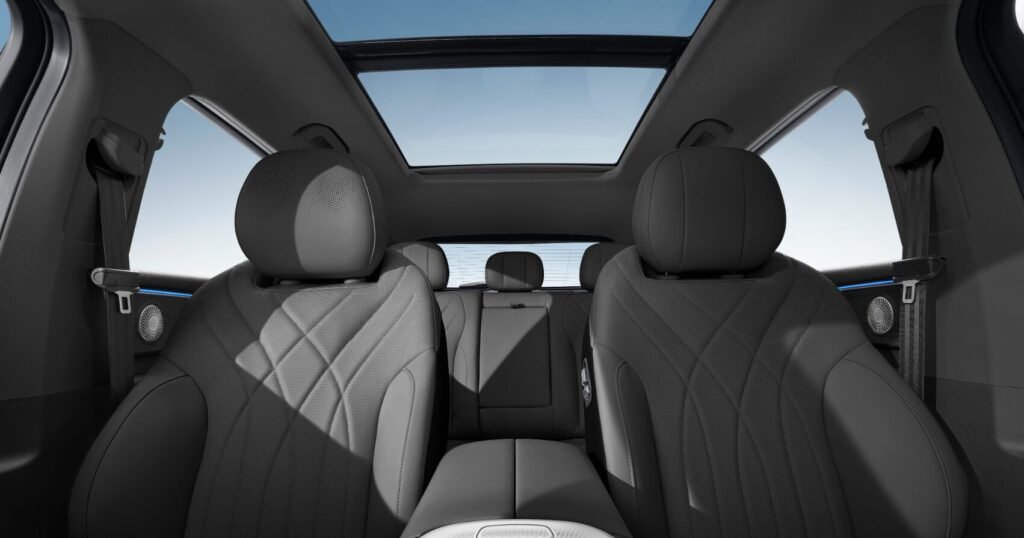
- Advanced Seating: Heated and ventilated seats are standard not only for the driver and front passenger but also for the two outer rear seats—a true luxury feature.
- Panoramic Sunroof: A full-length panoramic glass roof with an opening front section and an electric blind is included.
- Premium Audio: A 14-speaker sound system is provided by renowned audio specialist Sony.
- Advanced Parking Tech: A 540° panoramic view camera system provides a complete bird’s-eye view around the vehicle, supplemented by a “transparent” view that shows the ground directly underneath the car, aiding in precise manoeuvres.
- Driver Assistance: A comprehensive suite of 20 Advanced Driver-Assistance Systems (ADAS) is standard, featuring adaptive cruise control, lane-keeping assist, blind-spot monitoring, and a fully automatic parking function.
- Convenience Features: A 50W wireless phone charger with a cooling fan, multi-colour ambient lighting, and a power-operated tailgate are all included.
Practicality and Space: A Five-Seat Advantage
A critical point of differentiation for the Omoda 9 in the UK market is its configuration as a strict five-seater. While many of its key rivals like the Hyundai Santa Fe and Skoda Kodiaq are defined by their third row of seats, Omoda has prioritized space and comfort for five occupants. This results in what reviewers have described as “palatial” rear legroom, offering a level of passenger comfort that seven-seat rivals often compromise to accommodate the extra row. The boot is correspondingly large, with a generous
660-litre capacity, which is competitive with the best in the class when they are in five-seat mode.
The Achilles’ Heel: Driving Dynamics and User Interface
For all its on-paper brilliance, early reviews from UK-based test drives have revealed significant flaws in the Omoda 9’s dynamic tuning and user experience. These issues create a notable disconnect between how the car presents in a showroom and how it performs on the road.
- Ride and Handling: The suspension tuning appears ill-suited to typical British road conditions. It is described as being overly soft and “bouncy,” causing the vehicle to feel “unsettled” on undulating B-roads. Paradoxically, this softness does not translate into comfort over sharper imperfections, with jolts from potholes and speed bumps being transmitted harshly into the cabin.
- Infotainment and User Experience (UX): While the large central screen is responsive to touch, the software that runs on it has been widely criticized as “infuriating,” “baffling,” and “confusing to navigate”. Complex menu structures and unintuitive layouts for key functions detract from the premium-tech feel.
- Intrusive Driver Aids: Some of the ADAS features, particularly the lane-keeping assist, have been flagged as being too aggressive. Reviewers note that the system “constantly feels like it’s fighting you” for control of the steering, creating an unnatural and frustrating driving experience on the motorway.
This “showroom versus road” disconnect highlights a potential blind spot in Chery’s product development for the European market. The Omoda 9 is a masterclass in sourcing and integrating impressive hardware—the powerful motors, large battery, big screens, and premium-branded speakers. In a static showroom environment, it creates an overwhelming impression of quality and value. However, the true measure of a vehicle lies in the daily driving experience, where factors like a well-damped ride, intuitive controls, and seamlessly integrated driver aids become paramount. The consistent criticism in these areas suggests that while the hardware is excellent, the nuanced and iterative process of software optimization and chassis tuning required to satisfy discerning European drivers has not yet been mastered. This creates a veneer of quality that impresses at first glance but can be undermined once the journey begins, representing a significant hurdle for its long-term success in a market that values dynamic refinement so highly.
The UK Market Gauntlet: How Does the Omoda 9 Stack Up?
The Omoda 9 enters one of the most competitive segments in the UK, where it will be cross-shopped against a diverse range of mainstream and premium rivals. Its unique combination of strengths and weaknesses creates a complex but compelling value proposition. The following table provides a clear, data-driven overview of how the Omoda 9 compares to its most direct plug-in hybrid competitors.
| Feature | Omoda 9 SHS Noble | Hyundai Santa Fe PHEV Ultimate | Kia Sorento PHEV ‘4’ | Skoda Kodiaq iV SE L |
| On-The-Road Price (est.) | £44,990 | ~£57,745 | ~£57,135 | ~£50,000 |
| Powertrain | 1.5L Petrol PHEV | 1.6L Petrol PHEV | 1.6L Petrol PHEV | 1.5L Petrol PHEV |
| Combined Power (hp) | 443 hp | 249 hp | 252 hp | 204 hp |
| Official EV-Only Range | 93 miles | 33.6 miles | 35 miles | 75 miles |
| DC Fast Charging | Yes (70kW) | No | No | Yes (40kW) |
| Seating Capacity | 5 Seats | 7 Seats | 7 Seats | 7 Seats |
| Boot Space (5-seat mode) | 660 Litres | 628 Litres | 809 Litres | 845 Litres |
| Warranty | 7yr / 100k miles | 5yr / unlimited | 7yr / 100k miles | 3yr / 60k miles |
Mainstream Plug-in Hybrid Rivals
The most direct challenge for the Omoda 9 comes from the established large SUVs from Korea and the Czech Republic.
- Hyundai Santa Fe & Kia Sorento: These platform-sharing cousins are stalwarts of the family SUV market. Their single most significant advantage over the Omoda 9 is the availability of seven seats, which is often a primary purchasing driver in this segment. While both offer capable and reliable plug-in hybrid powertrains, their technology is a generation behind the Omoda 9. Their electric-only ranges are around 35 miles, and they lack DC fast-charging capability, making them far more reliant on their petrol engines. Their interiors are well-built, and their infotainment systems are widely regarded as more intuitive and user-friendly than the Omoda’s. However, they cannot match the sheer power, standard equipment list, or the groundbreaking EV range of their new Chinese rival, especially when considering the Omoda’s significant price advantage.
- Skoda Kodiaq: The Kodiaq is the benchmark for practicality in the segment, renowned for its cavernous interior, enormous boot, and “Simply Clever” features. The latest generation Kodiaq iV PHEV is a strong contender, offering an impressive 75-mile electric range and 40kW DC charging—vastly better than the Korean offerings, though still short of the Omoda 9’s figures. The Kodiaq’s key strengths lie in its impeccable ergonomics, comfortable and settled ride quality, and the strong brand reputation Skoda has built in the UK for reliability and owner satisfaction. Like the Santa Fe and Sorento, it also offers seven seats, making it a more versatile family hauler than the five-seat Omoda.
Premium Segment Aspirations
Omoda has been clear that it is targeting buyers who might otherwise consider premium brands.
- BMW X3 & Lexus NX: When compared against these premium benchmarks, the conversation shifts from practicality to brand prestige, build quality, and driving dynamics. The German and Japanese rivals offer a vastly superior brand image, more luxurious cabin materials with higher tactile quality, and a far more refined, engaging, and dynamically polished driving experience. However, this level of quality comes at a steep price. A BMW X3 or Lexus NX plug-in hybrid, specified to match the Omoda 9’s exhaustive standard equipment list, would cost tens of thousands of pounds more. This is the core of Omoda’s strategy: to tempt buyers with a specification sheet that rivals the premium players, but at a price point that undercuts them dramatically.
The Chinese Counterpart: Jaecoo 7
Within Chery’s own stable, the Jaecoo 7 provides an interesting point of comparison. As the more ruggedly styled sibling brand, the J7 also offers a plug-in hybrid powertrain with a respectable 57-mile electric range. However, it is a smaller, less powerful, and more affordable vehicle than the Omoda 9. This internal differentiation helps to cement the Omoda 9’s position as the flagship performance and technology leader within Chery’s initial UK product portfolio.
A Global Gambit: Omoda’s Worldwide Ambitions
The launch of the Omoda 9 in the United Kingdom is not an isolated event but a key move in a coordinated, multi-brand global offensive by Chery. By examining the company’s strategy in other key international markets, a clearer picture emerges of a sophisticated, region-specific approach to capturing market share from established players.
The Omoda/Jaecoo Duality
The vehicle platform underpinning the Omoda 9 is a versatile asset for Chery. In different markets, vehicles with similar technology and dimensions are being launched under the Jaecoo brand, tailored to local tastes.
- Case Study: Jaecoo J8 in Australia & South Africa: The Jaecoo J8, a large five-seat SUV conceptually and mechanically similar to the Omoda 9, has been launched in Australia and is slated for arrival in South Africa. In Australia, it is priced from approximately $50,000 AUD and is positioned as a high-value luxury offering, praised for its premium-feeling interior and extensive feature list but criticized for its unrefined driver aids and lack of brand recognition—a narrative that closely mirrors the Omoda 9’s reception in the UK. Its planned launch in South Africa in late 2024 further demonstrates a strategy of targeting markets receptive to new, value-oriented brands.
The Premium Frontier: The Exeed VX Case Study
In markets with a strong appetite for outright luxury, Chery deploys its dedicated premium brand, Exeed. This allows the company to compete at a higher price point without diluting the value-focused message of Omoda and Jaecoo.
- Market Focus: UAE & Russia: The Exeed VX is a large, seven-seat luxury SUV that serves as the brand’s flagship. In the United Arab Emirates (UAE), it is priced from AED 136,000 (approximately £29,000), a figure that allows it to directly challenge established luxury players by offering a comparable level of features and perceived quality for a fraction of the cost. Local reviews praise its styling and standard equipment but are critical of its limited off-road ability. Owner forums in the region reflect satisfaction with the value proposition but also raise concerns about minor electronic glitches and the long-term availability of parts and service support. In Russia, Chery’s strategy has been remarkably successful. The Exeed brand has broken into the top five best-selling automotive brands in the country, demonstrating an ability to rapidly capture significant market share in a major international market.
This multi-brand strategy is highly sophisticated, resembling the successful playbook of established giants like the Volkswagen Group. Rather than a “one-size-fits-all” approach of selling Chery-branded cars globally, the company has invested in creating distinct identities to attack different market segments. Omoda is the sporty, tech-focused brand for style-conscious markets like the UK and Europe. Jaecoo is the rugged, adventurous brand for markets like Australia and South Africa. Exeed is the full-premium disruptor for luxury-focused regions like the Middle East and Russia. This portfolio approach functions as a strategic “pincer movement,” allowing Chery to surround established Japanese, Korean, and European manufacturers from multiple angles simultaneously. It demonstrates a long-term, calculated vision where the launch of the Omoda 9 in the UK is not an experiment, but a key move on the European chessboard in a much larger global campaign.
Conclusion: A Compelling but Flawed Challenger
The Omoda 9 arrives in the UK as a vehicle of stark and fascinating contrasts. It is, without question, a technological trailblazer in the plug-in hybrid space. Its combination of a 93-mile electric range, 70kW DC fast-charging, and a sub-five-second 0-62mph time is a package that no other manufacturer currently offers, at any price. This revolutionary powertrain, wrapped in a spacious five-seat body and loaded with an exhaustive list of standard equipment for under £45,000, makes for an undeniably compelling value proposition.
However, this on-paper brilliance is significantly undermined by real-world flaws. The poorly damped and unsettled ride quality is a poor match for the UK’s challenging road network. The frustratingly complex infotainment system and overly intrusive driver aids betray a lack of the final layer of polish and user-centric refinement that buyers in this segment expect. Furthermore, as a brand-new entrant, Omoda carries the unavoidable burdens of zero brand heritage and an unproven track record for long-term reliability and dealer support.
Ultimately, the Omoda 9 is a “Version 1.0” product—brilliant in concept, but flawed in execution. Its appeal will be highly specific. For the tech-savvy early adopter, the fleet manager focused on Benefit-in-Kind tax advantages, or the pragmatic buyer who prioritizes cutting-edge powertrain technology and a maximalist specification sheet above all else, the Omoda 9 is a uniquely compelling option. These buyers must be willing to overlook the dynamic shortcomings and accept the inherent risks of a new brand.
For the majority of family SUV buyers, however, the calculus is different. Those who prioritize a polished and cohesive driving experience, intuitive technology that simplifies rather than complicates the journey, the practicality of seven seats, and the peace of mind that comes with an established brand and dealer network will likely find the Hyundai Santa Fe, Kia Sorento, or Skoda Kodiaq to be a more suitable, albeit technologically less advanced, choice.
The Omoda 9, for all its faults, is a significant moment for the UK car market. It is a powerful shot across the bow of the established automotive order, proving that Chinese brands are now capable of leading, not just following, in key areas of technology. The question that remains is whether they can master that final, crucial 10% of dynamic and ergonomic refinement needed to truly conquer one of the world’s most discerning markets. The Omoda 9 is a bold first step, but the journey has just begun.