Introduction to Automatic Parking Payment Systems
The evolution of parking payment solutions has witnessed a significant transition from traditional payment methods towards automatic parking payment systems. The primary purpose of these advanced systems is to enhance convenience for drivers, reduce time spent in payment processes, and minimize human errors associated with manual transactions. Traditional parking payment methods, such as pay-and-display machines or envelope systems, often require drivers to physically interact with machines, which can lead to frustrations such as machine malfunctions, long queues, or unclear instructions.
In contrast, automatic parking payment systems streamline this process through the integration of technology that facilitates seamless transactions. These systems may utilize various forms of technology, including sensors, mobile applications, and license plate recognition to determine a vehicle’s parking duration and automatically charge the appropriate fee without requiring any action from the driver. This technological innovation not only improves user experience but also optimizes parking management for cities and private operators by providing real-time data on parking space availability and usage patterns.
The emergence of vehicles equipped with cutting-edge technology further enhances the landscape of automatic parking payment systems. As cars become increasingly autonomous, the potential for vehicles to engage in parking payment transactions independently is no longer a distant possibility. Envision a future where your car can navigate to a parking space, assess the payment amount, and conduct the transaction on your behalf. Such advancements indicate a trajectory towards a more efficient urban ecosystem, where parking hassles are significantly diminished. Automatic payment systems represent a crucial component of this evolution, ultimately benefiting both drivers and urban infrastructure.
The Technology Behind Automatic Payment Systems
Automatic payment systems for parking utilize a blend of advanced technologies to facilitate seamless transactions between vehicles and parking infrastructure. One of the critical components of this system is the incorporation of sensors, which play a vital role in detecting vehicle presence, parking duration, and even maneuvering patterns. These sensors, often embedded within the parking spaces or integrated into vehicles, can relay real-time information about parking availability to drivers. This immediate feedback helps manage traffic flow in busy urban areas, reducing congestion and enhancing the overall parking experience.
Furthermore, the evolution of connectivity standards, particularly Vehicle-to-Everything (V2X), has significantly contributed to the effectiveness of these automatic payment systems. V2X is a communication framework that enables vehicles to interact not only with other vehicles but also with infrastructure, such as traffic lights and parking meters. This technology allows for instantaneous communication between a vehicle and parking management systems, facilitating automatic payment processing when a vehicle enters or exits a parking facility. By leveraging V2X communication, parking operators can create a more efficient environment that minimizes the need for physical interactions, thereby promoting contactless transactions.
In addition to sensors and V2X technology, mobile payment platforms have emerged as essential elements of the automatic parking payment ecosystem. These platforms enable users to manage their parking transactions conveniently via their smartphones. By using mobile applications, drivers can pay for parking without needing to interact with traditional kiosks or meters. This integration of mobile payments not only increases convenience for drivers but also streamlines the entire parking process. As the interconnectedness of these technologies continues to grow, the prospects for more sophisticated and user-friendly automatic parking payment systems look promising.
Current Innovations in the Automotive Industry
The automotive industry is undergoing rapid transformation, primarily driven by technological advancements aimed at enhancing user experiences and operational efficiencies. Among the most notable innovations are automatic payment capabilities for parking, a feature that many industry players are actively researching and developing. Major car manufacturers, alongside tech giants, are collaborating to integrate sophisticated systems into vehicles, ensuring seamless financial transactions while parked.
Leading automotive companies are exploring various approaches to implement automatic payment systems. For instance, manufacturers like Tesla and BMW are progressing towards integrated software solutions that allow vehicles to communicate with parking infrastructures. These innovations could enable cars to autonomously find, reserve, and pay for parking through a commercial or proprietary app. Such an approach not only streamlines the parking process for users but also minimizes the need for physical interactions with payment kiosks, ultimately increasing convenience.
In addition to traditional car manufacturers, tech companies are also stepping into the fold, developing key technologies that facilitate these innovations. Companies like Google and Apple are investing in enhancing vehicle-to-everything (V2X) communication. This technology allows vehicles to interact with parking meters or mobile payment platforms, making automatic payments a reality. Furthermore, various prototypes are currently being tested in urban environments to assess their feasibility and efficiency in real-world scenarios. These pilots focus on utilizing sensors and artificial intelligence to recognize parking spaces and trigger payments upon vehicle entry and exit.
These advancements underscore the automotive industry’s commitment to embracing technology that not only meets consumer demands but also addresses the complexities of urban mobility. Automatic payment systems, through continuous innovations, are poised to revolutionize how we perceive the parking experience, paving the way for a more autonomous future.
How Does Automatic Parking Payment Work?
The integration of technology into everyday tasks has significantly transformed the parking experience, particularly through the implementation of automatic payment systems. This innovation primarily revolves around vehicles equipped with advanced sensors and technology that facilitate seamless transactions. The entire process can be broken down into several key stages.
First, as a vehicle approaches a parking area, it utilizes GPS and parking availability data to identify open spaces. This information is often collected through networks of interconnected devices and sensors that monitor parking spots in real-time. Once a suitable parking slot is identified, the vehicle can navigate autonomously to the space, reducing the time drivers typically spend searching for parking.
Upon occupying a designated space, the car interacts with the payment system, which is commonly integrated into parking meters or mobile applications. Using vehicle-to-infrastructure (V2I) communication, the car communicates its presence and parking duration to the payment platform. In this phase, several authentication and identification protocols are employed, ensuring that the vehicle can be securely recognized by the system.
The payment process can occur in multiple ways. For instance, many systems are linked to the owner’s account, where settings for automatic payment are established. When the car is parked, funds are deducted based on the duration of stay, without the need for manual payment initiation. Additionally, reservations made by the driver through mobile apps prior to their arrival further streamline the process, allowing for pre-payment and minimizing station time.
Such systems not only enhance convenience but also improve efficiency, leading to reduced congestion caused by cars searching for parking spaces. As technology continues to advance, the prospect of fully automated parking payment systems appears increasingly feasible, promising an even more streamlined driving and parking experience in the future.
Privacy and Security Concerns
As the integration of automatic payment systems in vehicles becomes more prevalent, concerns surrounding privacy and security have emerged as critical issues. Automatic parking payment systems rely on the collection and transmission of vast amounts of personal and financial data. This data typically includes vehicle identification information, payment credentials, and location data, which raises questions about how this information is stored and protected.
Data breaches represent one of the most significant risks associated with these systems. Cybercriminals continuously seek vulnerabilities in software and networks to exploit and extract sensitive information. As autonomous payment systems become more integrated into both urban infrastructure and individual vehicles, the potential for larger-scale data breaches increases. Consequently, companies implementing these systems must prioritize cybersecurity measures, encompassing strong encryption protocols and regular security audits to safeguard consumer data effectively.
The handling of personal and financial information within these systems also presents potential vulnerabilities. For instance, if a vehicle is compromised, attackers may gain access to not only the car’s operational systems but also the owner’s payment information. Therefore, manufacturers and service providers must establish robust identity verification processes and secure channels for communication between the vehicle, payment systems, and backend servers, thereby ensuring that user data remains confidential and secure.
While the convenience offered by automatic payment systems is undeniable, it is imperative that users remain informed about potential risks to their privacy and security. Users should be encouraged to understand how their data is used and what measures are in place to protect it. Furthermore, governments and regulatory organizations may need to establish guidelines that mandate transparency in data handling practices, ensuring that consumers can enjoy the benefits of these innovations without sacrificing their privacy and security.
Benefits of Automatic Payment for Parking
The proliferation of automatic payment systems for parking presents numerous advantages that significantly enhance both driver experience and urban management. One of the primary benefits is the streamlined parking experience. With automatic payment options, drivers can bypass traditional payment methods that often involve lines, cash transactions, or coins. Instead, they can rely on seamless digital payments, transforming how they access parking spaces. This convenience fosters a more efficient parking process, allowing motorists to focus on their destination rather than dealing with cumbersome payment procedures.
Moreover, automatic payment systems play a crucial role in reducing congestion in busy urban areas. By minimizing the time spent finding and securing parking, these systems alleviate the strain on road networks, cutting down on traffic associated with searching for available spots. This not only improves the driving experience but also leads to a decrease in emissions from idling vehicles. Consequently, cities can benefit from reduced air pollution and a more harmonious flow of traffic.
Time savings are another significant advantage of implementing automatic payment systems. Drivers can quickly pay for parking using mobile applications, RFID technology, or license plate recognition, which eliminates the need for manual entry or physical payment methods. This elevated efficiency allows users to allocate their time more effectively, enhancing overall user satisfaction. Furthermore, such systems can offer notifications about parking status, such as time remaining or expiration alerts, thus allowing drivers to stay informed without constant monitoring.
Lastly, automatic payment systems have positive implications for urban management. Cities can gather data on parking patterns, leading to better planning and resource allocation. This information empowers urban planners to optimize parking availability based on demand, improving the community’s overall accessibility and infrastructure. As a result, integrating automatic payment systems represents a pivotal advancement for both drivers and urban environments.
Challenges and Limitations of Current Systems
As the concept of autonomous payment systems in vehicles gains traction, several challenges and limitations hinder their widespread adoption. One of the primary obstacles lies in technological hurdles. The integration of vehicle software with parking meters and payment gateways depends on advanced communication protocols, such as Vehicle-to-Everything (V2X) technology. These systems must be developed to ensure secure, seamless interactions between the car and parking infrastructure, but current technologies are still developing and may not yet meet the necessary standards for safety and reliability.
Moreover, the integration with existing infrastructure poses a significant challenge. Many municipalities and private parking facilities still utilize outdated payment systems that are not equipped to interact with modern autonomous payment platforms. Upgrading this infrastructure would demand substantial investment and effort on the part of stakeholders. This situation is exacerbated by a lack of unified standards across different regions and parking facilities, which could lead to compatibility issues and inhibit the scalability of these autonomous systems.
User acceptance also remains a crucial factor. Many vehicle owners may be hesitant to adopt automatic payment systems due to concerns about privacy, security, and loss of control over financial transactions. Educating the public about the benefits of such technologies is essential; without user buy-in, the implementation of autonomous payment systems will be slow and fraught with resistance.
Lastly, comprehensive regulatory frameworks are necessary to guide the development and deployment of these systems. Governments must collaborate with technology developers and parking operators to establish clear regulations that address data protection, liability, and operational standards. This multifaceted challenge presents a realistic picture of the current landscape surrounding autonomous payment systems, while suggesting that future improvements are vital for overcoming these limitations.
The Future of Automatic Payment Technology in Vehicles
The landscape of automatic payment technology is continuously evolving, particularly within the automotive industry. As cities grow smarter, the integration of advanced technology into vehicles is becoming increasingly necessary, and automatic parking payment systems are at the forefront of this transition. In the realm of smart cities, infrastructure is being developed to accommodate seamless interactions between vehicles and parking facilities. This fusion aims to reduce friction for drivers, creating a more efficient urban environment.
The evolution of vehicle technology serves as a catalyst for these innovative payment systems. Modern vehicles are being equipped with sophisticated sensors and connected capabilities that allow for real-time communication with parking meters and municipal databases. As cars become more autonomous, the ability to handle transactions without direct user intervention will become a staple feature. Through advancements like vehicle-to-infrastructure (V2I) communication, automatic payment systems could allow cars to pay for parking upon arrival, enhancing the overall user experience while providing streamlined revenue collection for municipalities.
Public policy is also expected to adapt to support the emergence of these technologies. Policymakers may begin to craft regulations that foster innovation while ensuring security and privacy for users. With increasing investments in smart infrastructure, local governments have an incentive to encourage the development of automatic payment solutions that not only boost urban efficiency but also reduce congestion and improve environmental outcomes. These regulations could pave the way for further integration with other smart services, such as digital wallets and ride-sharing platforms, making the payment process even more convenient for drivers.
In this context, the future of automatic payment technology in vehicles holds great promise. As both technology and policy evolve, consumers can expect a more streamlined approach to parking, marked by advancements that prioritize efficiency and user-friendliness.
Conclusion: The Road Ahead for Cars and Autonomous Payment
As we navigate through an era marked by rapid technological advancements, the concept of autonomous payment systems for vehicles emerges as a significant development. The shift toward integrating automatic payment solutions directly into cars not only presents a transformative approach to parking but also signals a broader evolution in the way urban transportation operates. By enabling vehicles to handle payments without human intervention, we can anticipate a future characterized by increased convenience and efficiency for drivers.
The integration of automatic payment systems offers numerous benefits, foremost among them being the alleviation of stress associated with parking. Motorists could experience smoother transitions from driving to parking, as their vehicles autonomously manage the payment process. This innovation could significantly reduce the time spent searching for parking or fumbling for loose change, thereby streamlining daily commutes and encouraging the use of urban spaces.
Moreover, such systems have the potential to revolutionize traffic management. With real-time data collection on parking occupancy and payment transactions, urban planners can gain insights into usage patterns and optimize space allocation in crowded areas. This capability could lead to reduced congestion and improved traffic flow, ultimately contributing to a more sustainable urban environment.
As we embark on this journey towards incorporating autonomous payment technology into personal vehicles, it is crucial for stakeholders, including auto manufacturers, urban planners, and policymakers, to engage in fruitful discussions about the implications of this technology. Stakeholders must address potential challenges, including data privacy concerns and the need for comprehensive regulatory frameworks. Encouraging dialogue among communities about these evolving technologies will aid in shaping a future that embraces both innovation and the enhancement of urban mobility.
Equipping your vehicle with the right car accessories transforms everyday commutes and long motorway journeys alike into safer, more organised, and stress-free experiences. Our comprehensive UK testing highlights the ten indispensable interior and breakdown essentials every British motorist should keep on board.
Our editorial team independently assesses motoring accessories based on real-world utility in UK driving and parking environments. Evaluation criteria include build quality under damp British weather conditions, ease of fitment across common UK boot sizes (hatchbacks, estates, and SUVs), anti-theft reliability in public car parks, and long-term value for money. We only recommend accessories that meet strict motorist security and convenience standards.
Whether you are navigating narrow country lanes in the Scottish Highlands, dealing with stop-start crawling along the M25, or preparing for unpredictable British winters, carrying the right car accessories is vital. Modern motoring demands more than just a full tank of petrol or a charged battery; it requires smart tech to protect your insurance no-claims bonus, dependable maintenance tools to handle sudden roadside punctures, and practical interior solutions to keep your cabin tidy.
At Parking Management Network UK, our team has rigorously tested dozens of aftermarket motoring gadgets across thousands of miles. We evaluated each item on practicality, build quality, value for money, and suitability for UK weather and road regulations. From cutting-edge 4K dash cams that withstand freezing overnight temperatures to rapid tyre inflators and rugged boot organisers, here are the top 10 car accessories that deserve a permanent spot in your vehicle.
Nextbase 622GW 4K Dash Cam
In an era of rising insurance premiums across the UK, a dependable dash cam is the single most valuable car accessory you can invest in. The Nextbase 622GW remains our benchmark model, delivering flawless 4K recording at 30fps alongside What3words emergency geolocation. On rain-slicked dual carriageways at dusk, its built-in digital image stabilisation and enhanced night mode successfully capture number plates that cheaper alternatives blur. The modular design lets you attach a rear-facing camera to capture tailgaters on the motorway, while the magnetic Click&Go PRO mount makes removing the unit effortless when parked in high-risk areas.
- Crystal-clear 4K resolution with superb low-light detail
- Integrated What3words helps emergency services locate you without mobile signal
- Super-smooth digital image stabilisation handles bumpy UK B-roads
- Extreme weather mode enhances clarity through dense British fog and rain
- Premium price point compared to entry-level cameras
- Requires a high-end U3 micro-SD card (sold separately)
| Resolution | 4K Ultra HD at 30fps |
|---|---|
| Viewing Angle | 140 degrees |
| Connectivity | Wi-Fi, Bluetooth 5.0 |
| Display | 3-inch HD IPS Touchscreen |
Michelin 12266 Programmable Rapid Digital Tyre Inflator
Fluctuating seasonal temperatures in the UK cause tyre pressures to drop dramatically, directly impacting fuel economy and MOT compliance. The Michelin 12266 inflator is our top pick for roadside peace of mind. Powered via the 12V auxiliary socket, it inflated a standard 13-inch car tyre from flat to 35 PSI in under three minutes during our timed trials. The digital pressure preset automatically shuts off when your chosen PSI or Bar is reached, eliminating guesswork in the freezing cold. An integrated, ultra-bright LED strip illuminates the valve stem during nighttime emergencies on unlit rural lanes.
- Rapid inflation speed with pin-point digital gauge accuracy (+/- 1 PSI)
- Auto-stop function prevents over-inflation
- Long 3-metre power lead effortlessly reaches all four corners of estate cars and SUVs
- Built-in LED work light and secondary USB socket for charging phones
- Audible operational noise during heavy compression
- Can become noticeably warm after inflating multiple large tyres consecutively
| Max Pressure | 50 PSI (Car tyres) |
|---|---|
| Power Source | 12V DC auxiliary socket |
| Cord Length | 3 metres |
| Weight | 1.25 kg |
NOCO Boost Plus GB40 1000A Lithium Jump Starter
Flat batteries account for a significant proportion of UK breakdown callouts each winter. The NOCO Boost Plus GB40 eliminates the need to flag down a Good Samaritan or wait two hours for roadside recovery. Delivering 1,000 amps of peak starting power, this compact lithium pack easily cranks petrol engines up to 6.0 litres and diesels up to 3.0 litres. Its patented UltraSafe design provides spark-proof connections and reverse-polarity protection, ensuring you cannot damage your car’s sensitive ECUs even if you mistakenly connect the clamps back to front. It also doubles as a high-capacity power bank.
- Jump-starts engines up to 20 times on a single internal charge
- Foolproof spark-proof clamps with reverse-polarity alerts
- Compact enough to store in your glove box or door bin
- Integrated 100-lumen emergency LED torch with SOS strobe mode
- Recharges via Micro-USB rather than modern USB-C
- Supplied storage bag offers minimal impact protection
| Peak Amperage | 1000A |
|---|---|
| Engine Compatibility | Up to 6.0L Petrol, 3.0L Diesel |
| Battery Capacity | 24 Watt-Hours Lithium-Ion |
| Weight | 1.09 kg |
ThisWorx High Power Handheld Car Vacuum Cleaner
Between muddy walking boots, family road-trip snacks, and pet hair, car footwells quickly accumulate grime. The ThisWorx corded vacuum cleaner plugs straight into your car’s 12V cigarette lighter, providing continuous, fade-free suction without worrying about flat rechargeable batteries. In testing, its 106W motor and double-filtration HEPA system effectively lifted dry mud, grit, and biscuit crumbs from deep carpet pile. The package includes three bespoke nozzle attachments—including an elongated crevice tool for sliding between seats and the centre console—making cabin tidying effortless.
- Continuous 12V power eliminates cordless battery degradation
- Includes flathead nozzle, extendable flex hose, and brush head
- Washable dual HEPA filter traps fine allergens and dust
- 4.8-metre cable reaches into estate boots and back seats with ease
- Requires car engine to be running to achieve optimum suction
- Not designed for sucking up standing liquids
| Power Rating | 106 Watts |
|---|---|
| Power Cable Length | 4.8 metres (16 ft) |
| Filtration | Washable HEPA Filter |
| Weight | 1.0 kg |
VANMASS Universal Windscreen and Air Vent Phone Mount
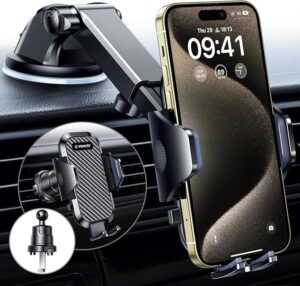
UK laws regarding mobile phone usage while driving carry strict penalties of six penalty points and a £200 fine. The VANMASS mount keeps your smartphone securely within your peripheral vision for hands-free satellite navigation without breaching highway laws. Constructed from military-grade PTFE plastic, it features an ultra-strong suction base that withstands sub-zero frosty mornings and boiling hot cabin glass without detaching. The side arms open with a one-touch button and feature soft silicone pads that cradle large smartphones, even when fitted with bulky shockproof cases.
- Rock-solid suction mechanism tested against severe road vibration
- Supplied with both heavy-duty suction arm and steel-hook air vent clip
- 360-degree ball joint allows seamless switching between landscape and portrait
- Deep side clamps support thick cases and large screen sizes
- Large suction arm can take up noticeable windscreen space on smaller hatchbacks
- No built-in wireless charging capability
| Mounting Style | Suction pad (Windscreen/Dash) & Air Vent Clip |
|---|---|
| Device Width Support | 4.0 to 7.0 inches |
| Material | Aviation-grade PTFE & Silicone |
| Weight | 320 g |
Drive Auto Products Collapsible Car Boot Organiser
Few things are more irritating than grocery bags rolling around and spilling contents across your boot liner during tight cornering. This heavy-duty organiser from Drive Auto Products solves that problem with reinforced Oxford fabric panels and a rigid sub-base. It features tie-down straps with metal clips that hook directly into your boot’s luggage anchor points, keeping screen wash bottles, de-icer cans, and warning triangles entirely stationary. The collapsible design folds down into a neat, slim briefcase when not required, leaving maximum room for prams or luggage.
- Adjustable tie-down straps anchor the unit securely to boot eyelets
- Reinforced base plates prevent sagging under heavy cargo
- Multiple exterior mesh pockets store torches, scrapers, and rags
- Easily folds in half for smaller boots or fully flat when not in use
- Inner dividers are secured by Velcro rather than sewn-in seams
- Not 100% waterproof if chemical bottles leak inside
| Material | Heavy-duty 600D Oxford Polyester |
|---|---|
| Dimensions (Expanded) | 58 x 43 x 28 cm |
| Colour | Black |
| Weight | 1.9 kg |
Anker 323 52.5W USB-C Car Fast Charger
Modern drivers rely heavily on smartphones for GPS navigation and music streaming, both of which drain batteries at a rapid rate. The Anker 323 is an ultra-compact dual-port 12V/24V adapter that delivers modern fast-charging speeds without cluttering the centre console. The 30W Power Delivery (PD) USB-C port charges an iPhone or modern Android handset to 50% in roughly 25 minutes, while the secondary 22.5W USB-A port simultaneously charges a passenger device or dash cam. Anker’s MultiProtect temperature safety system ensures your connected devices remain shielded against short-circuits and voltage spikes.
- Simultaneous high-speed dual charging (30W USB-C + 22.5W USB-A)
- Sits almost flush with most standard 12V vehicle sockets
- Gentle, non-distracting LED ring makes locating ports easy at night
- Superior heat dissipation compared to generic budget adapters
- Does not include charging cables in the box
- USB-C port caps out at 30W, so large laptops charge slowly
| Total Output | 52.5 Watts |
|---|---|
| Ports | 1x USB-C (30W PD), 1x USB-A (22.5W) |
| Input Voltage | 12V / 24V |
| Weight | 32 g |
Everlasting Comfort Ergonomic Memory Foam Car Seat Cushion
Long motorway slogs across the UK can quickly take a toll on your lower back, tailbone, and sciatic nerve—especially in older cars or firm sporty seats. The Everlasting Comfort cushion uses 100% premium, heat-responsive memory foam cut into an ergonomic wedge profile. It slightly raises your driving hip angle, relieving lumbar pressure while simultaneously improving your forward viewing angle over the bonnet. The textured non-slip rubber bottom keeps it locked in place on both cloth and leather seats, and the breathable, removable mesh cover can be tossed into the washing machine.
- Tailbone cut-out reduces coccyx and spinal compression on long drives
- Wedge shape gently improves posture and driving visibility
- Non-slip micro-dot rubber base prevents shifting during sudden stops
- Washable, breathable outer cover prevents perspiration buildup
- Raises driving seating height by roughly 2 to 3 cm (check head clearance)
- Firmness increases slightly in freezing winter temperatures until body heat warms it
| Core Material | 100% Pure Memory Foam |
|---|---|
| Cover Material | Breathable Polyester Mesh |
| Dimensions | 43 x 36 x 8 cm |
| Weight | 650 g |
Syncwire Bluetooth 5.3 FM Transmitter
If you drive an older car lacking Apple CarPlay, Android Auto, or factory Bluetooth audio, the Syncwire Bluetooth 5.3 FM Transmitter is the fastest and most cost-effective upgrade available. It pairs to your phone within seconds and broadcasts Spotify playlists, podcasts, or sat-nav directions directly through an unassigned FM frequency on your car radio. During our testing, the upgraded Bluetooth 5.3 chip provided zero dropouts, while the dual noise-cancelling microphones with CVC 8.0 technology filtered out road tyre noise for clean, audible hands-free phone calls.
- Brings modern hands-free calls and wireless audio to any older vehicle
- Bluetooth 5.3 ensures instant pairing and minimal latency
- Dual noise-cancelling microphones deliver clear call clarity
- Features quick-charge 3.0 and Type-C charging slots on the front face
- Requires finding a totally vacant FM frequency in densely populated areas
- Audio quality depends partly on your factory car radio aerial
| Bluetooth Version | 5.3 |
|---|---|
| FM Frequency Range | 87.5 – 108.0 MHz |
| Charging Ports | 1x PD 30W Type-C, 1x QC 3.0 USB-A |
| Weight | 45 g |
Kärcher EDI 4 Cordless Electric Ice Scraper
Scraping stubborn windscreen ice on freezing January mornings is one of the most frustrating parts of UK car ownership. The Kärcher EDI 4 makes conventional plastic scrapers completely redundant. Powered by an internal lithium-ion battery, it uses a rotating disc equipped with six durable plastic blades. With gentle downward pressure, the disc spins automatically, stripping thick frost and sheet ice in minutes without scratching automotive safety glass. A single full charge easily handles up to 15 windscreen clearances, making it an indispensable cold-weather accessory.
- Effortlessly clears dense windscreen frost in a fraction of the time
- Smart pressure-activation switch operates only when pressed down
- Blades are made of non-scratch composite plastic safe for car glass
- Integrated lithium battery holds charge reliably across cold winter weeks
- Requires proprietary charging cable rather than standard USB-C
- Plastic rotating disc blades need replacing after several seasons of heavy frost
| Battery Type | Lithium-Ion (Integrated) |
|---|---|
| Run Time | Approx. 15 minutes (multi-day use) |
| Disc Diameter | 100 mm |
| Weight | 550 g |
Comprehensive UK Buyer’s Guide
1. Understanding UK Motoring Laws & Compliance
Before outfitting your vehicle with gadgets, it is essential to ensure they comply with UK motoring regulations. Under Rule 30 of the Highway Code and Section 40a of the Road Traffic Act 1988, drivers must have a clear view of the road and traffic ahead. When installing dash cams or phone holders, fit them outside the swept area of the windscreen wipers—typically behind the rearview mirror or low down on the dashboard. Furthermore, strict mobile phone laws forbid holding or handling a mobile phone for any reason while driving, even at red lights. Investing in a robust, hands-free phone cradle or Bluetooth hands-free kit is legally imperative to avoid six penalty points and hefty fines.
2. Prioritising Emergency & Breakdown Preparedness
British weather and road conditions can deteriorate rapidly, making emergency equipment the most critical accessories in your car. A lithium jump starter (such as the NOCO GB40) eliminates the vulnerability of being stranded with a dead 12V battery, especially in freezing weather when battery capacity naturally plummets. Equally important is a programmable digital tyre inflator; under-inflated tyres increase fuel consumption, wear unevenly, and compromise braking distances on wet roads. Ensure these items are securely stored in the boot or under the passenger seat so they do not become dangerous projectiles during hard braking.
3. Cabin Organisation and Driving Comfort
Clutter in your cabin is not only irritating; loose cans, water bottles, and bulky items can roll beneath pedals and cause dangerous driving hazards. High-sided boot organisers with securing straps ensure shopping bags, detailing bottles, and de-icers remain in place through tight roundabouts. For drivers who frequently tackle motorway mileage along the M1, M6, or M25, ergonomics matter. Ergonomic memory foam seat wedges relieve tailbone compression, align the spine, and maintain comfortable posture across long road trips.
4. Power Management and Port Selection
With multiple electronic accessories running inside modern cars, selecting the right power adapters is vital. Always look for chargers that offer Power Delivery (PD) over USB-C alongside Quick Charge (QC) USB-A ports to support various devices simultaneously. Ensure any 12V auxiliary plug-in device features internal surge protection to safeguard your vehicle’s alternator and electrical wiring from unexpected voltage spikes.
Frequently Asked Questions
Q: Are dash cams legal in the UK, and do they lower insurance premiums?
Yes, dash cams are completely legal across the UK, provided they are mounted so they do not obstruct more than 40mm of the swept windscreen area directly ahead of the driver. Many leading UK car insurance providers offer policy discounts (typically between 5% and 15%) for drivers who install approved dash cams, as footage provides definitive proof in non-fault accidents and protects against fraudulent ‘crash for cash’ scams.
Q: What car accessories are legally required when driving in the UK?
Unlike parts of continental Europe where high-vis vests, warning triangles, and breathalysers are legally mandated, the UK does not require private motorists to carry specific emergency equipment by law. However, having a working spare tyre or tyre repair kit, an inflator, a high-vis jacket, and a jump starter is strongly advised by the RAC, AA, and emergency services.
Q: Will leaving 12V accessories plugged in drain my car battery overnight?
It depends on your vehicle. In many modern European cars (such as Volkswagen, Audi, and Ford), 12V auxiliary cigarette sockets automatically shut off power a few minutes after the ignition is switched off. However, in some older vehicles or specific Asian models, the socket remains permanently live. If your 12V port stays active with the key removed, unplug dash cams, phone chargers, and cool boxes to prevent battery drain.
Q: Can I use an electric ice scraper or de-icer spray on tinted windows?
Electric scrapers (like the Kärcher EDI 4) are designed for exterior glass only and should never be used on the inside of the vehicle, where window tint films are applied. For exterior frosted glass, electric scrapers and high-quality chemical de-icers are completely safe and will not damage factory glass or rubber wiper seals.
Final Verdict: Which Should You Choose?
Upgrading your vehicle with high-quality car accessories pays dividends in safety, reliability, and everyday driving pleasure. For insurance peace of mind and accident protection, our top overall recommendation is the **Nextbase 622GW Dash Cam**, which sets the gold standard for image quality and British breakdown navigation. For essential roadside self-sufficiency, pairing the **NOCO Boost Plus GB40 Jump Starter** with the **Michelin 12266 Rapid Tyre Inflator** ensures that flat batteries and pressure drops will never leave you stranded on the hard shoulder. Choose the accessories that align with your vehicle’s age and your daily commuting habits to enjoy a safer, better-equipped driving experience across the UK.
Affiliate Disclosure: Parking Management Network UK is a participant in the Amazon Services LLC Associates Program. As an Amazon Associate, we earn from qualifying purchases at no extra cost to you. Product prices, ratings, and availability are subject to change on Amazon.co.uk.
Check out more articles

Why Do You Need a Rearview Mirror Dash Cam?

Discover the Best EV Charger Finder Tool: Charge Your Journey

Electric Vehicle Charging: What Motorists Need to Know

Why Do You Need a Universal Car Phone Holder with Wireless Charging?

Why Do You Need a Car GPS Tracker?