



Introduction: Chery’s Calculated Arrival on UK Shores
The United Kingdom’s automotive market is in the midst of a profound transformation, with the arrival of Chery Automobile marking the latest and perhaps most significant move in a strategic expansion by major Chinese automotive groups. This is not the isolated launch of a fledgling brand; it is the calculated deployment of a global heavyweight into one of Europe’s most competitive arenas. While UK consumers may already be familiar with new entrants like BYD, or even Chery’s own subsidiary brands Omoda and Jaecoo, the arrival of the parent Chery brand itself signals a new phase in this market shift.
To understand the potential impact of Chery’s arrival is to first dismiss any notion of it being a newcomer. Chery International is a global automotive powerhouse, a fact substantiated by decades of formidable performance. The company has held the title of China’s top passenger vehicle exporter for an astonishing 22 consecutive years, establishing a commercial presence in over 80 countries and cultivating a global user base that now exceeds 14 million drivers. In 2024 alone, Chery Group reported staggering global sales of over 2.6 million vehicles, with exports accounting for more than 1.14 million units. This is not a speculative venture; it is the expansion of a proven, high-volume global operation.
The spearhead for its UK volume strategy is the Tiggo 7 family, comprising the petrol-powered Tiggo 7 Pro and the technologically advanced Tiggo 7 Super Hybrid. While the larger, seven-seat Tiggo 8 was the first model to officially open for orders, it is the five-seat Tiggo 7 that is poised to be the high-volume challenger, aimed directly at the heart of the UK’s fiercely contested compact and medium SUV segment. This market entry is a masterclass in strategic sequencing. By first launching the Omoda and Jaecoo sub-brands in late 2024 and early 2025, Chery has effectively established a logistical and commercial beachhead. These brands have already secured a combined UK market share of approximately 2% and, crucially, have built a foundational dealer network that the parent Chery brand will now leverage for its own launch. Chery UK’s leadership has explicitly stated they have been “learning from our experience” with these initial brands to “refine and refresh our approach”. This methodical approach significantly de-risks the launch, allowing for a more confident and aggressive market penetration.
This report will argue that the Chery Tiggo 7, in both its petrol and plug-in hybrid forms, represents a significant disruptive threat to the established market order. Its combination of aggressive pricing, a high-level standard specification that rivals premium brands, and advanced hybrid technology is engineered to force a fundamental re-evaluation of value in the segment, presenting a formidable challenge to incumbent leaders and a compelling proposition for UK consumers and fleet operators alike.
The Petrol Contender: A Deep Dive into the Chery Tiggo 7 Pro
The Chery Tiggo 7 Pro is the conventional internal combustion engine (ICE) offering that will form the bedrock of the brand’s volume sales strategy. It is a vehicle meticulously designed to challenge the status quo, not through revolutionary engineering, but through an overwhelming value proposition that begins the moment a potential customer opens the door.
Exterior Design & Dimensions: A Familiar Face with Premium Aspirations
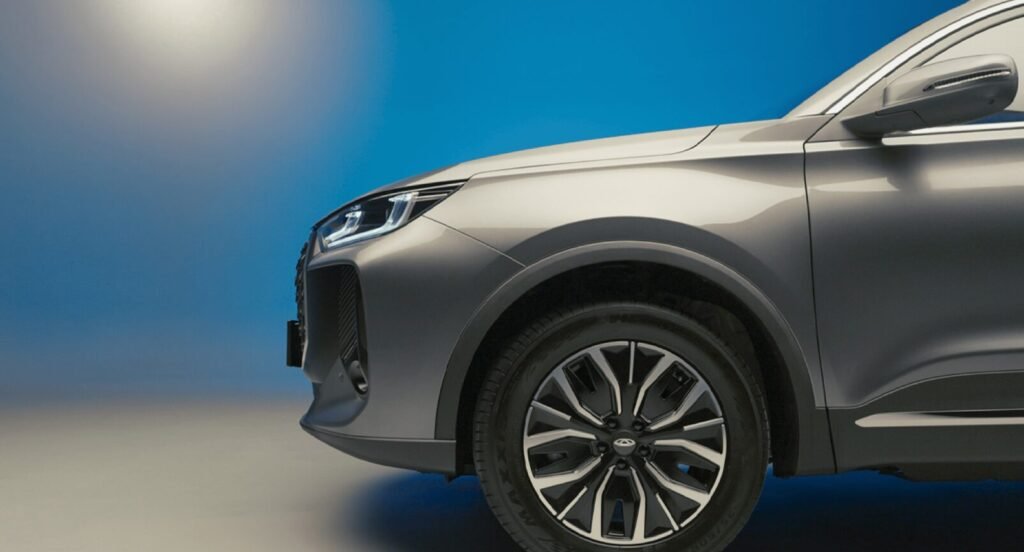
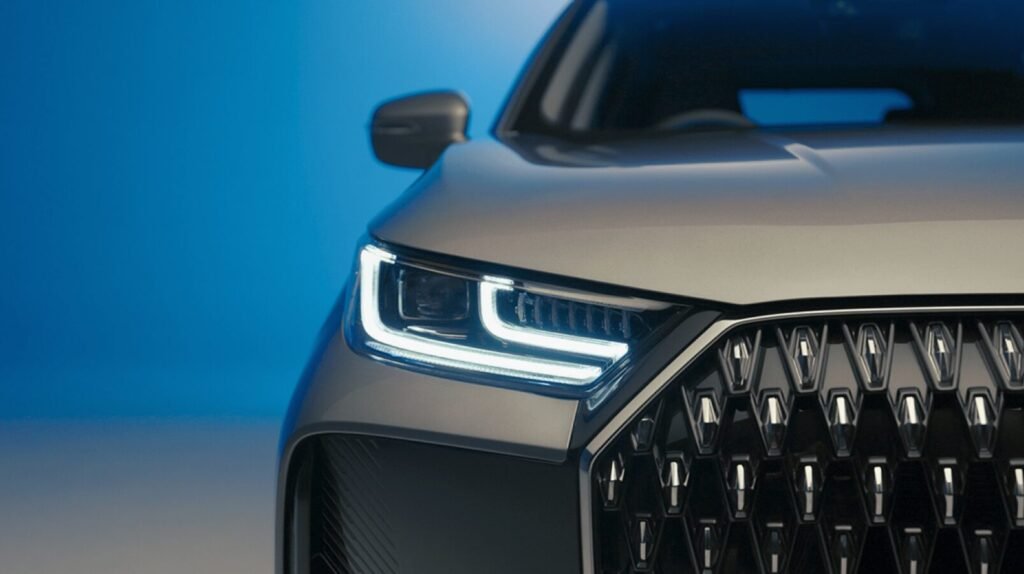
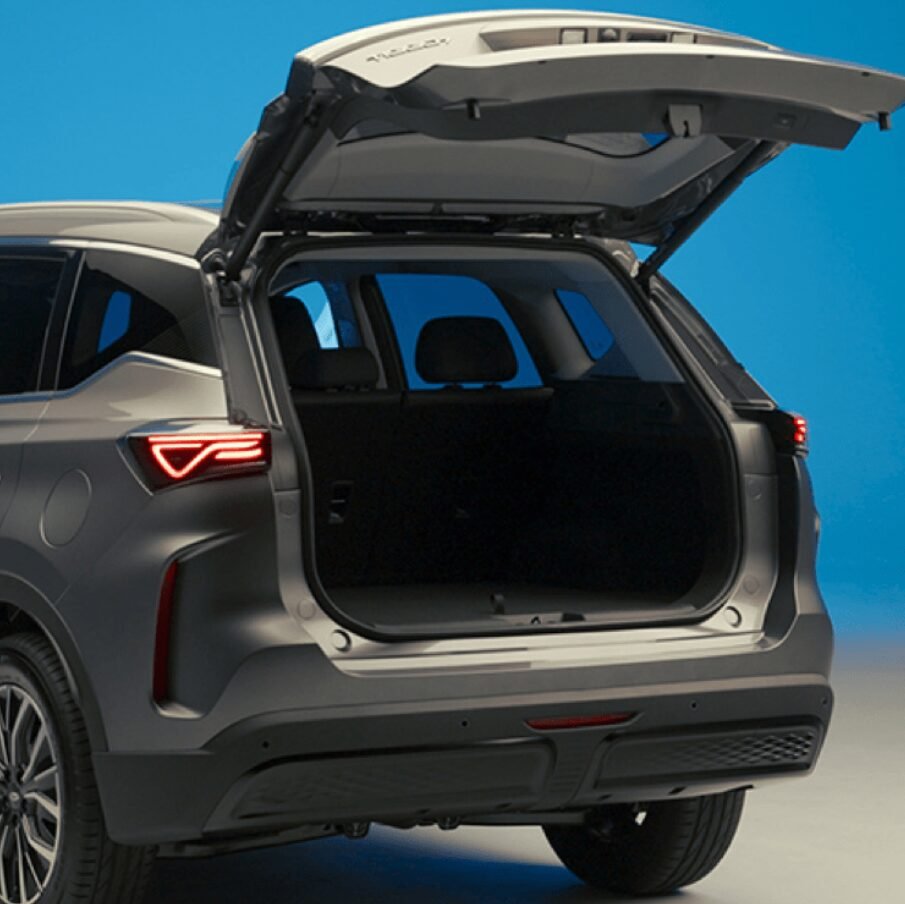
The Tiggo 7 Pro’s exterior design is a study in contemporary, globally-minded aesthetics. Chery has deliberately eschewed polarising styling in favour of a design that feels modern, substantial, and aligned with European tastes. The front is dominated by the brand’s signature “Diamond Front Grille,” a large, intricate feature that lends the vehicle a confident and upmarket presence. This is flanked by sharp, slender “Matrix LED Headlights” that are standard across the range, a feature often reserved for higher trim levels on competing models.
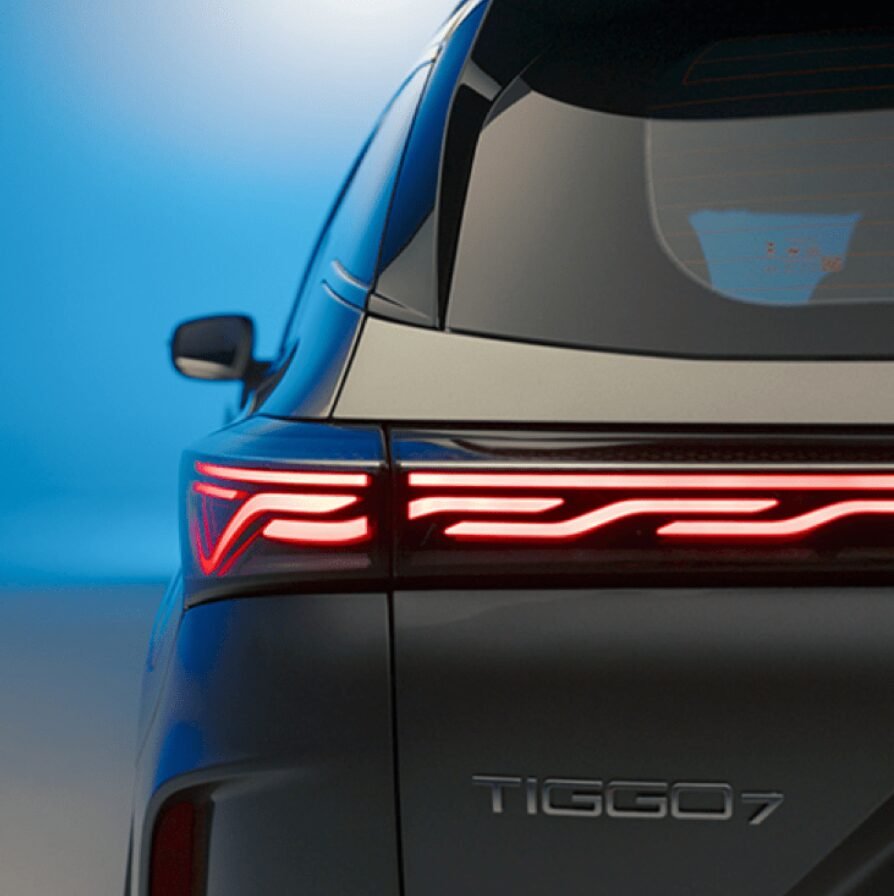
The side profile is clean, with a strong shoulder line and a “Suspended Sky Roof Design” that creates a floating effect, enhanced by options for a dual-colour body. At the rear, an integrated crescent-shaped LED tail lamp stretches across the width of the vehicle, another design cue typically associated with more premium offerings. The overall impression is one of sophistication and solidity.
In terms of physical footprint, the Tiggo 7 Pro is sized perfectly for the UK market. With a length of 4513 mm, a width of 1862 mm, and a height of 1696 mm, it fits squarely within the medium SUV class. These dimensions ensure it is spacious enough for family duties while remaining manageable for navigating tight city streets and fitting comfortably within a standard UK parking bay (typically 4.8m x 2.4m).
The Cabin Experience: Redefining the “Budget” Interior
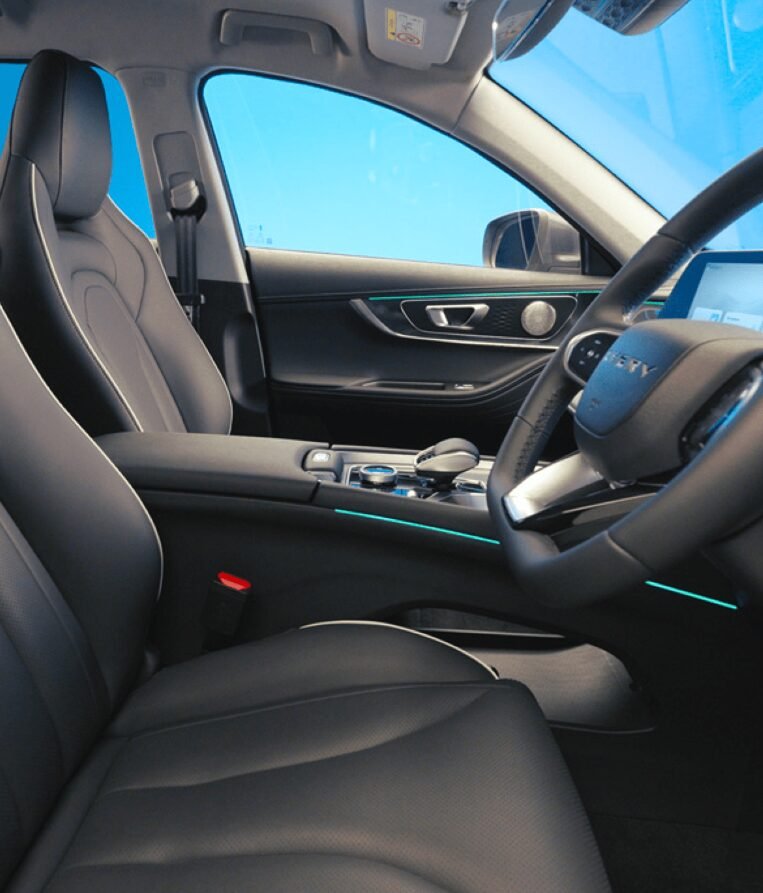
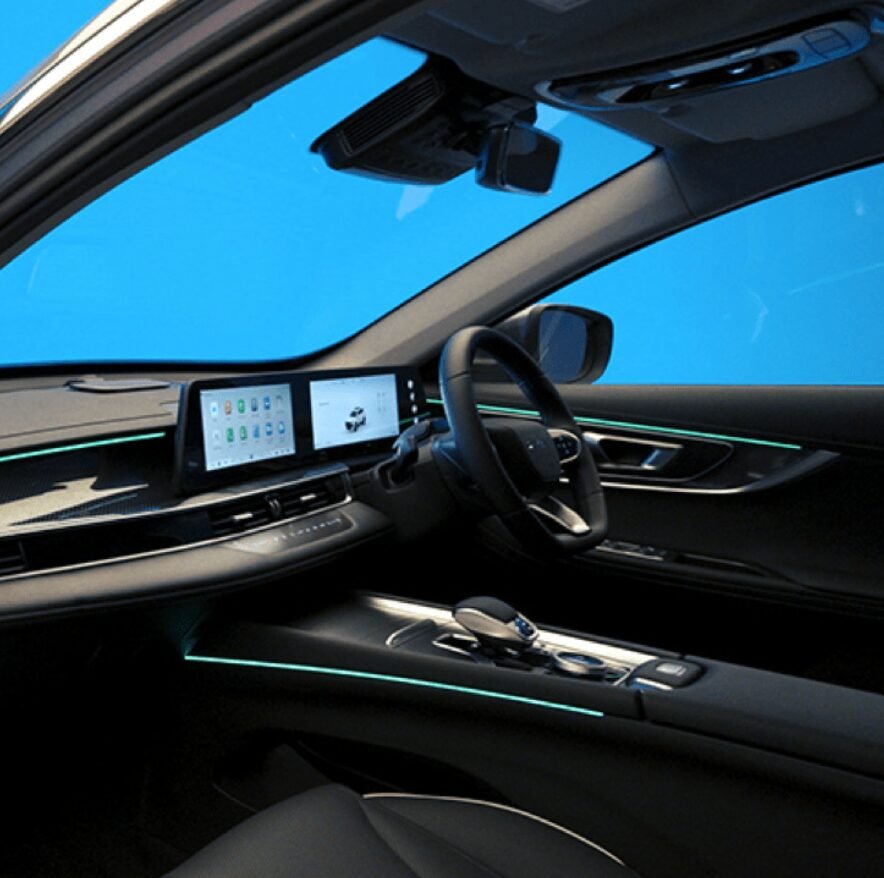
If the exterior is designed to attract, the interior is engineered to convert. This is arguably the Tiggo 7 Pro’s most potent weapon. Upon entering the cabin, the immediate impression is one of quality and technology that seems incongruous with its expected price point. The dashboard is dominated by a sweeping dual-screen setup, comprising two 12.3-inch LCD displays—one for the digital instrument cluster and one for the central multimedia touchscreen—housed under a single pane of glass for a seamless, modern look.
The perceived quality is exceptionally high, with extensive use of soft-touch materials, artificial leather, and thoughtful design details throughout the cabin. Reviewers consistently note that Chery has dared them to “find a hard and scratchy surface,” with the vast majority of touchpoints being padded or leatherette-wrapped, which also contributes to impressive noise, vibration, and harshness (NVH) suppression.
The standard technology suite is comprehensive. All models are expected to feature wireless Apple CarPlay and Android Auto, a powerful 50W wireless charging pad, an 8-speaker Sony premium sound system, and the “Hello Chery” intelligent voice command system. Higher trims add features like multi-colour ambient lighting, heated and ventilated front seats, and a driver’s seat with memory function. While the system is feature-rich, some reviews have noted occasional lag in the interface and pointed out charming quirks like the built-in navigation system being named ‘Turbodog’.
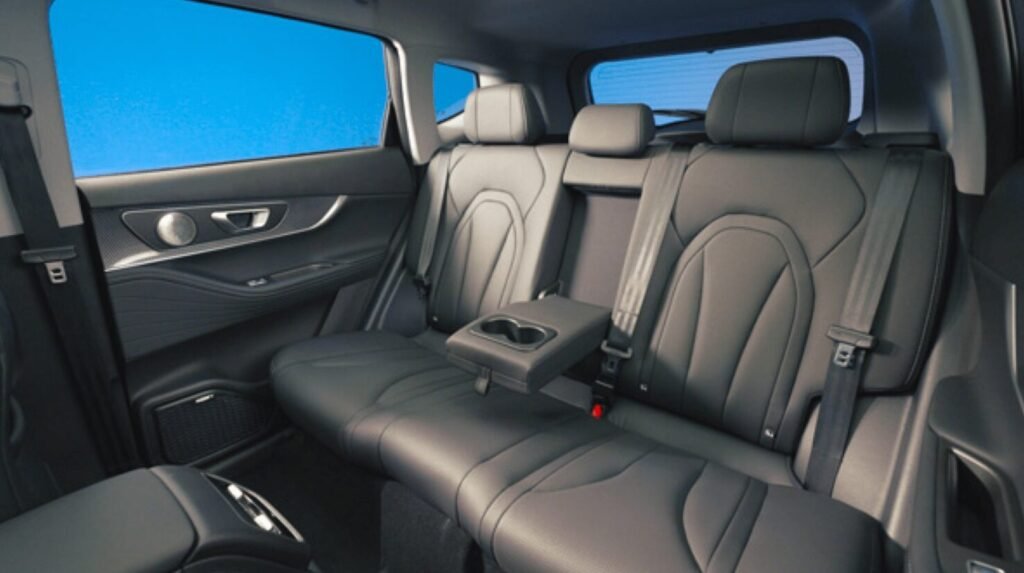
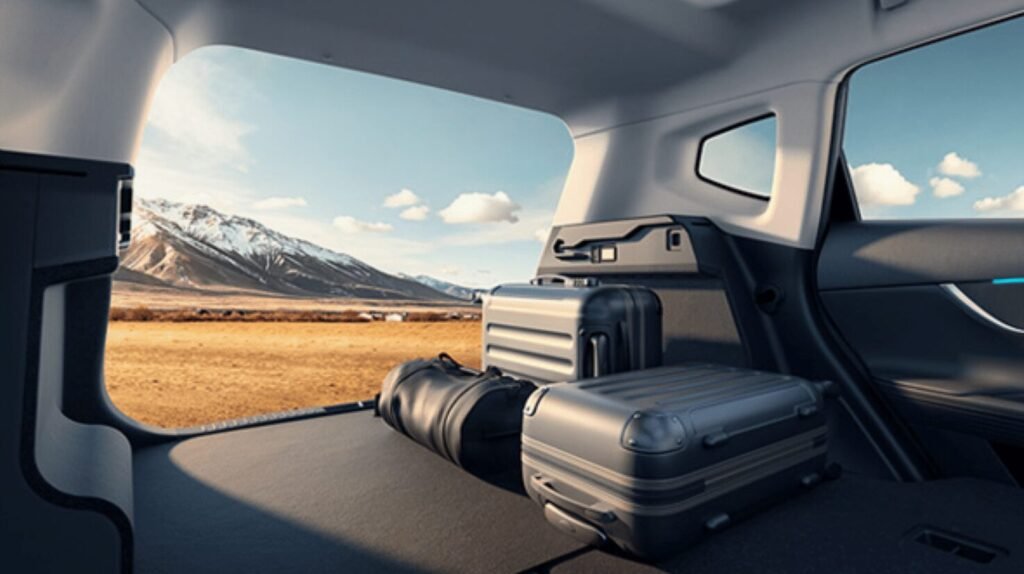
Practicality is another area where the Tiggo 7 Pro excels. The rear passenger area is exceptionally spacious, offering ample legroom, headroom, and toe-room even for adults over six feet tall, a clear advantage over some key rivals. The boot is cavernous, offering a class-leading 626 litres of luggage capacity with the rear seats in place, expanding to a van-like 1672 litres when they are folded down. This focus on space and practicality is a clear strategic choice to appeal directly to UK families.
The vehicle’s value proposition appears heavily weighted towards these tangible, easily demonstrable features that create a winning “showroom impression.” The large screens, premium-feeling materials, vast interior space, and long list of standard features are what customers see and touch first. This strategy aims to establish an overwhelming sense of value before a test drive even begins, where more subtle dynamic compromises might become apparent.
Powertrain & Performance: Capable but Unrefined?
The primary powertrain for the UK market is expected to be a 1.6-litre turbocharged direct injection (TGDI) petrol engine. This unit produces a healthy 137 kW (approximately 184 bhp) and 275 Nm of torque, channelled to the front wheels via a seven-speed dual-clutch transmission (DCT). An all-wheel-drive (AWD) version is also available in other markets and may be offered as a top-tier option in the UK.
On the move, performance is generally regarded as more than adequate. The engine is responsive, particularly when the drive mode is set to ‘Sport’, and the 275 Nm of torque is available from a low 2000 rpm, giving the car a sense of urgency when accelerating or overtaking. The 0-100km/h (0-62mph) time is quoted at around 9.5 seconds for the front-wheel-drive model, which is competitive for the class.
However, a consistent point of criticism in real-world reviews centres on the low-speed refinement of the 7-speed DCT. While it performs well at cruising speeds with smooth and quick shifts, it can exhibit jerkiness and hesitation in stop-start urban traffic—a critical consideration for UK drivers. This is a common characteristic of some DCT systems, and it represents the most significant compromise in the Tiggo 7 Pro’s dynamic package. The driving experience is further shaped by a suspension setup—comprising MacPherson struts at the front and a sophisticated multi-link arrangement at the rear—that is clearly tuned for comfort over outright agility. The ride is compliant and does a good job of absorbing road imperfections, but it does not offer the engaging handling of more driver-focused rivals.
This highlights the deliberate engineering trade-offs made by Chery. The focus is on maximizing perceived value in static features, backed by a comprehensive warranty to build confidence, while accepting that the dynamic experience is simply adequate rather than class-leading. For a large portion of the target market, this calculation—trading a degree of powertrain polish for a significantly higher specification and more space at a lower price—is likely to be a very compelling one.
The Electrified Disruptor: Unpacking the Tiggo 7 Super Hybrid (PHEV)
While the petrol Tiggo 7 Pro aims to compete on value, the Tiggo 7 Super Hybrid is engineered to disrupt on technology and efficiency. This Plug-in Hybrid Electric Vehicle (PHEV) variant is not merely an afterthought; it is a technologically advanced offering designed to challenge the best in the segment and appeal directly to the cost-conscious and environmentally aware UK buyer, particularly within the lucrative fleet market.
Chery’s Super Hybrid Technology Explained
The core of the Super Hybrid is a sophisticated powertrain that combines a fifth-generation 1.5-litre turbocharged petrol engine producing 105 kW (141 bhp) and 215 Nm of torque with a powerful permanent magnet synchronous electric motor that generates 150 kW (201 bhp) and 310 Nm of torque. Power is sent to the front wheels through a specialised Dedicated Hybrid Transmission (DHT), which is designed to seamlessly manage the power flow from both sources.
This combination results in impressive on-paper specifications. The system delivers a pure electric range of up to 93 km (58 miles) on the NEDC cycle, which translates to an expected WLTP range of around 56 miles—more than enough to cover the average UK daily commute on electric power alone. When working in concert, the petrol and electric systems provide a massive combined driving range of over 1000-1200 km (over 620-745 miles) from a full battery and its 60-litre fuel tank. The official combined fuel consumption is a headline-grabbing 1.4 L/100km (approximately 201.8 mpg), with CO2 emissions as low as 23-33 g/km, placing it in an extremely favourable position for UK company car tax.
Charging, Range, and Real-World Efficiency
A key differentiator for the Tiggo 7 Super Hybrid is its advanced charging capability. It is equipped with an 18.3 kWh Lithium Iron Phosphate (LFP) battery pack, which can be charged via both AC and DC connections. While it supports standard home and public AC charging at up to 6.6 kW, its standout feature is its compatibility with DC rapid chargers at speeds of up to 40 kW. This allows the battery to be replenished from 30% to 80% in just 20 minutes, a significant practical advantage that dramatically reduces downtime and is rare among PHEVs in this class, many of which are limited to slower AC charging only.
While official fuel economy figures for PHEVs are often difficult to replicate, real-world tests have proven the Super Hybrid system to be genuinely efficient. In launch drives where the vehicle was not plugged in and started with a depleted battery, testers still recorded impressive consumption figures around 3.8 L/100km (approximately 74.3 mpg) over mixed driving routes. This demonstrates the system’s effectiveness as a conventional hybrid even when not regularly charged. Furthermore, the ability to run on cheaper 91 RON (E10) unleaded petrol, unlike many European rivals that demand premium 95 RON fuel, adds another layer of cost-saving for owners.
The Driving Experience: Two Cars in One
The Super Hybrid system offers drivers distinct modes, primarily EV and HEV (Hybrid Electric Vehicle), allowing it to function as two different cars. In EV mode, it provides a smooth, silent, and responsive driving experience, capable of operating on pure electric power at speeds up to 120 km/h (75 mph). This makes it ideal for urban commuting and daily errands, delivering the quiet refinement of a full electric vehicle.
When more power is required, or on longer journeys once the battery is depleted, the system seamlessly transitions to HEV mode. Reviewers have consistently praised the imperceptible nature of this transition, with the petrol engine engaging smoothly to either assist the electric motor or take over propulsion. The DHT intelligently manages the power sources across nine different working modes to optimise for either performance or efficiency depending on the driving conditions. However, some initial reviews have noted that the ride can feel “unsettled and brittle” on rougher UK-style B-roads and that the steering feels overly light and vague, indicating that while the powertrain is refined, the chassis tuning may still require further calibration for discerning European drivers.
The specifications of the Tiggo 7 Super Hybrid appear to be meticulously tailored to address and overcome the primary objections UK fleet managers have towards large-scale electrification. The vehicle’s design choices directly counter concerns about range anxiety, charging time, and, most critically, the total cost of ownership (TCO). This positions the Super Hybrid as a highly strategic “Trojan Horse” for accelerating fleet adoption. The extremely low CO2 emissions place it in a minimal Benefit-in-Kind (BIK) tax bracket, a powerful financial incentive for company car drivers. The massive combined range of over 700 miles completely nullifies range anxiety, a major barrier for high-mileage business users. The unique DC fast-charging capability minimises operational downtime, while the efficient hybrid mode ensures the vehicle remains fully functional even if charging infrastructure is unavailable, unlike a pure BEV. Combined with a low acquisition price and the ability to use cheaper fuel, the Super Hybrid presents an overwhelmingly logical case on a fleet manager’s spreadsheet, making it a low-risk, financially compelling alternative to traditional diesel and petrol fleets.
Head-to-Head: The Tiggo 7 vs. The UK’s Best-Sellers
The Chery Tiggo 7 is not entering a vacuum; it is launching into the UK’s most saturated and fiercely defended automotive segment. To succeed, it must go head-to-head with established titans like the Nissan Qashqai, Kia Sportage, and Hyundai Tucson—vehicles that have dominated sales charts for years. The following analysis breaks down how the Tiggo 7’s disruptive value proposition stacks up against these market leaders.
The table below provides a direct, data-driven comparison of the key specifications that influence purchasing and leasing decisions in this class. It is designed to quantify the value gap that Chery is strategically targeting.
Table: UK Compact/Medium SUV Competitive Landscape
| Feature | Chery Tiggo 7 Pro | Chery Tiggo 7 Super Hybrid | Nissan Qashqai | Kia Sportage | Hyundai Tucson |
| Starting Price (Est. UK) | ~£24,995 | ~£29,995 | ~£28,000+ | ~£30,885 | ~£33,080+ |
| Key Engine Option | 1.6L Turbo Petrol | 1.5L Turbo PHEV | 1.5L e-Power Hybrid | 1.6L Turbo Hybrid | 1.6L Turbo Hybrid |
| Power (bhp) | ~184 bhp | ~201 bhp (Electric Motor) | ~188-202 bhp | ~212-235 bhp | ~215 bhp |
| Boot Space (Litres) | 626 L | ~475 L* | 455 – 504 L | 587 – 591 L | 577 – 620 L |
| Key Hybrid Spec | N/A | PHEV, ~56 miles EV range (WLTP) | Self-charging series hybrid | Self-charging parallel hybrid | Self-charging parallel hybrid |
| Std. Infotainment Screen | 12.3-inch | 12.3-inch | 8-inch / 12.3-inch | 12.3-inch | 12.3-inch |
| Warranty | 7 years / 100,000 miles | 7 years / 100,000 miles | 3 years / 60,000 miles | 7 years / 100,000 miles | 5 years / Unlimited miles |
*Boot space for the Super Hybrid is reduced compared to the petrol model due to the battery pack; figures for similar PHEV versions of the petrol model suggest around 475L.
Analysis of the Showdown
- Price & Value: The data clearly illustrates the Tiggo 7’s primary weapon: price. An expected starting price of around £24,995 for the petrol model and under £30,000 for the PHEV dramatically undercuts its main rivals. A similarly specified Kia Sportage or Hyundai Tucson could command a premium of several thousand pounds. This forces competitors into an uncomfortable position: either de-specify their entry-level models to compete on price, thereby sacrificing their own value proposition, or risk appearing significantly overpriced in a direct comparison.
- Practicality: The petrol Tiggo 7 Pro’s 626-litre boot is a standout feature, surpassing the already generous capacities of the Kia Sportage (up to 591 litres) and Hyundai Tucson (up to 620 litres), and significantly larger than the Nissan Qashqai’s 504 litres. For family buyers, this tangible advantage in luggage space is a powerful selling point that is easy to demonstrate and appreciate. Even the reduced capacity of the Super Hybrid model remains competitive within the segment.
- Hybrid Technology: This is where the strategic differences become most apparent. The Tiggo 7 Super Hybrid offers a full plug-in experience with a substantial ~56-mile electric range and the unique benefit of DC fast charging. This positions it as a more versatile option for drivers who can utilize the electric range for daily driving but need the flexibility of petrol for longer journeys. In contrast, the Sportage and Tucson offer conventional self-charging hybrid systems that provide efficiency benefits but no meaningful electric-only range. The Nissan Qashqai’s e-Power system is a unique series hybrid where the petrol engine acts solely as a generator, providing an EV-like driving feel without a plug, but it lacks the ability to run for extended distances on pure battery power. The Chery’s PHEV system is arguably the most technologically flexible of the four, offering the best of both worlds for mixed-use driving.
- Brand & Dynamics: The established players hold a clear advantage in brand recognition, dealer network maturity, and perceived long-term resale value. This brand equity is a powerful, albeit intangible, asset. Furthermore, decades of tuning vehicles for European roads mean that models like the Sportage and Qashqai will likely offer a more refined and engaging driving experience, particularly in terms of handling and powertrain calibration. These are the key pillars that incumbent brands must rely on to justify their price premium against the onslaught of the Tiggo 7’s feature-per-pound superiority.
A Global Blueprint for Success: The Tiggo 7’s International Campaign
The Chery Tiggo 7’s impending arrival in the UK is not an experimental foray but the next logical step in a well-established and highly successful global expansion strategy. By examining its performance and positioning in other key international markets, we can discern the blueprint Chery is likely to follow and predict its potential for success in the UK with greater confidence.
Mapping the Global Footprint
The Tiggo 7 is a truly global product, adapted and sold in a diverse array of markets that span continents and consumer preferences. It has a significant presence in Australia, South Africa, Russia, Mexico, the Philippines, and across Southeast Asia, the Middle East, and South America. This widespread distribution demonstrates the model’s inherent adaptability to different climates, road conditions, and regulatory environments. Chery’s extensive logistical experience is underscored by the recent milestone of exporting its one-millionth Tiggo 7 unit, a clear testament to the model’s global appeal and commercial success. The model has garnered numerous international accolades, including “Best Midsize SUV to Buy” in Brazil and “Best Crossover (SUV)” in Saudi Arabia, further cementing its credentials on the world stage.
International Pricing Snapshot
An analysis of the Tiggo 7’s pricing in other right-hand-drive (RHD) and high-volume markets reveals a consistent strategy of aggressive, value-led positioning. This data provides a strong foundation for the expected UK price points, showing that the competitive pricing is not a one-off tactic but a core element of Chery’s global market entry playbook.
Table: Chery Tiggo 7 International Pricing Comparison
| Market | Tiggo 7 Pro (Local Currency) | Tiggo 7 Pro (GBP Equivalent*) | Tiggo 7 Super Hybrid (Local Currency) | Tiggo 7 Super Hybrid (GBP Equivalent*) |
| Australia | From AU$29,990 (Driveaway) | ~£15,700 | From AU$39,990 (Driveaway) | ~£20,900 |
| South Africa | From R389,900 | ~£16,900 | From R609,900** | ~£26,400 |
| United Kingdom (Est.) | ~£24,995 | £24,995 | ~£29,995 | £29,995 |
*GBP equivalents are approximate, based on exchange rates at the time of writing, and are for comparative purposes only. Local taxes and specifications vary. **South African market has a Tiggo 7 Pro Max AWD at this price point; a direct PHEV equivalent is not listed but this represents the top of the range.
The table demonstrates that the expected UK pricing, while higher than direct currency conversions from Australia and South Africa, remains strategically positioned to significantly undercut the established competition, consistent with Chery’s global approach.
Case Study: Australia – The PHEV Price Leader
The Australian market serves as a particularly relevant precedent for the UK launch. When the Tiggo 7 Super Hybrid was introduced in Australia in mid-2025, it debuted with the headline-grabbing title of being the country’s most affordable plug-in hybrid SUV. With a drive-away price starting from AU$39,990, it massively undercut established PHEV rivals like the Mitsubishi Outlander PHEV (from AU$57,290) and even other Chinese challengers such as the GWM Haval H6 PHEV (AU$47,990).
This strategy achieved two key objectives: it generated significant media attention and immediately positioned the vehicle as the undisputed value leader in the electrified space. It is highly probable that Chery will replicate this exact strategy in the UK, aiming to launch the Tiggo 7 Super Hybrid at a price point that makes it the most affordable PHEV in its class. This tactic allows the brand to cut through the noise of a crowded market and force its way into the consideration set of buyers who might previously have thought a new PHEV was financially out of reach.
The Verdict: Is the Chery Tiggo 7 the Smart Money for UK Drivers and Fleets?
After an exhaustive analysis of its technical specifications, competitive positioning, and global track record, the Chery Tiggo 7 emerges as a formidable new contender in the UK’s compact SUV market. It is a vehicle that forces a re-evaluation of the relationship between price, features, and quality. However, its potential for success is not without caveats, and the ultimate decision for buyers and fleet managers will depend on a careful weighing of its undeniable strengths against its documented weaknesses.
Synthesizing the Pros and Cons
The Tiggo 7’s strengths are compelling and immediately apparent. Its core appeal lies in an unbeatable value-for-features proposition, packing a level of standard equipment, technology, and interior quality that is typically associated with vehicles in a much higher price bracket. The cabin is not just well-equipped but also exceptionally spacious and practical, particularly the cavernous boot of the petrol model, which outclasses nearly all its rivals. The Super Hybrid variant adds another layer of appeal with a technologically advanced and highly efficient PHEV powertrain that boasts an impressive electric range and class-leading DC fast-charging capabilities. This entire package is underpinned by a comprehensive 7-year warranty, designed to build consumer confidence.
Conversely, the weaknesses, while less immediately obvious, are significant. The primary concern for drivers will be the unrefined low-speed performance of the petrol model’s dual-clutch transmission, which can be jerky in the urban environments where these vehicles spend much of their time. Furthermore, numerous reviews from other markets have criticised the over-sensitive and intrusive nature of some of the Advanced Driver Assistance Systems (ADAS), with the driver monitoring system in particular being a source of frustration. Finally, as a new brand in the UK, Chery faces challenges of unproven long-term reliability and the significant question mark that hangs over future resale values—a critical component of the total cost of ownership equation.
Overcoming the Perception Gap
Chery is acutely aware of the scepticism that can greet new brands, particularly those from China, in a mature market like the UK. Its strategy to overcome this perception gap is multi-faceted. The most visible tool is the 7-year/100,000-mile warranty, a clear statement of intent designed to match the best in the industry (notably Kia) and directly address concerns about durability and after-sales support. Beyond the warranty, the strategic decision to leverage the physical dealer network established by Omoda and Jaecoo is crucial. This provides a tangible, nationwide presence for sales, servicing, and support, offering a level of reassurance that online-only or sparsely represented brands cannot match. This investment in a traditional franchise dealer model signals a long-term commitment to the UK market.
The Fleet Market Disruptor
While the Tiggo 7 will undoubtedly attract value-conscious families, its most significant and immediate impact is likely to be felt in the UK fleet market. The Super Hybrid variant, in particular, seems almost purpose-built to appeal to the data-driven world of fleet procurement. Its extremely low CO2 emissions figure translates directly into a low Benefit-in-Kind (BIK) tax liability for company car drivers, making it financially very attractive. For fleet managers, the vehicle checks all the right boxes: a low initial acquisition cost, impressive real-world fuel economy, a high level of standard safety equipment, and the practicality required of a business-use vehicle. The long warranty provides peace of mind over a typical 3-to-4-year lease cycle, helping to de-risk the investment in a new and unfamiliar brand.
Final Recommendation
The Chery Tiggo 7 is not a perfect vehicle, but its imperfections are arguably in areas that a growing number of pragmatic buyers are willing to overlook in exchange for overwhelming value elsewhere. For the badge-conscious consumer or the keen driver who prioritises dynamic polish above all else, the established European and Korean rivals may still hold the edge.
However, for the value-driven family seeking maximum space, technology, and safety for their budget, the Tiggo 7 Pro presents a logical and financially compelling package that is difficult to ignore. For the company car driver or fleet manager, the Tiggo 7 Super Hybrid is a disruptive force that rewrites the rulebook on affordable, low-tax, electrified motoring.
Ultimately, the Chery Tiggo 7 is more than just another SUV. It is a clear and powerful signal that the competitive landscape of the UK automotive market is being permanently redrawn. It is a “must-test-drive” for families and a “must-calculate” for fleet operators, and its arrival will undoubtedly force every competitor in the segment to look long and hard at their own pricing and value equations.
