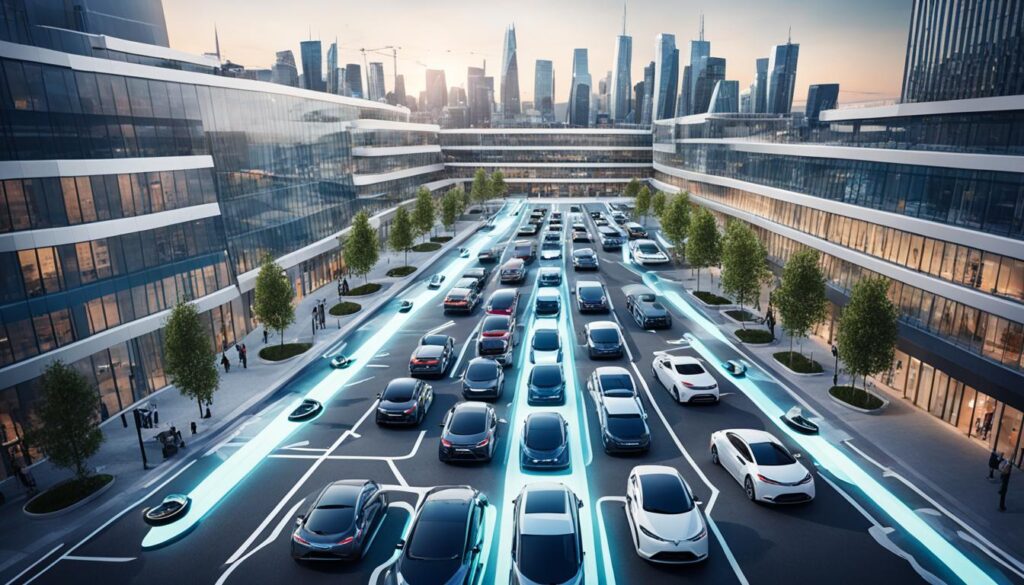
Did you know that up to 30% of traffic in downtown comes from cars looking for parking? This fact shows cities have big problems handling urban travel and parking. But, smart city parking projects are changing how we deal with these issues. These schemes use the latest technology to better handle traffic through clever parking systems and advice.
By using smart parking infrastructure, dynamic pricing and payment systems, parking guidance and navigation, data analytics, and integration with public transportation, modern city efforts are fighting against traffic jams, losses for businesses, and poor parking control. This helps make the city a better place for everyone. Cities need new, smart ways to overcome the steady growth in vehicle numbers caused by more people living in urban areas. Smart parking projects lead the change, showing a future with smoother, more eco-friendly city travel.
Key Takeaways
- Smart city parking initiatives use high-tech to simplify city travel via smart parking management and advice.
- They focus on solving the issues of traffic jams, business losses, and bad parking management seen in cities everywhere.
- Using smart parking systems, plus dynamic payment methods and advice, can make it easier to park and cut down on traffic.
- These projects make living in the city better by using new solutions to manage parking and traffic.
- The use of IoT-enabled parking infrastructure, parking guidance applications, and data-driven parking analytics is critical in smart city parking plans.
The Challenges of Urban Parking
Cities all over the world are tackling big issues with traffic congestion. This problem has a major impact. It’s been found that about 30% of all traffic in busy areas comes from cars looking for somewhere to park. This makes things tough for everyone else on the road. Also, it means many parking spots aren’t being used.
Poor parking situations can hurt local businesses. People might steer clear if parking is hard to find. This results in revenue losses for the businesses there. Cities face challenges too, with their inefficient parking management. Shockingly, just 5% of parking violations are addressed, meaning cities lose out on money. This cash could be used to help and protect people.
| Challenge | Impact |
|---|---|
| Traffic Congestion | Up to 30% of downtown traffic is caused by cars searching for parking, leading to delays and inefficiency. |
| Revenue Loss for Businesses | Customers avoid areas with difficult parking, resulting in decreased revenue for local businesses. |
| Inefficient Parking Management | Only 5% of parking violations are cited, leading to a loss of valuable revenue for cities. |
These urban parking challenges and parking-related urban issues show the need for creative fixes. We need solutions to enhance our city life and back movements that are eco-friendly.
Understanding Smart Parking Technology
Cities are using smart tech to deal with the struggles of finding parking spaces in busy areas.
Advanced solutions like sensors and cameras are helping. These tech pieces spot free places. Then, they send this live info through the Internet of Things (IoT) connectivity. On the other end, a real-time parking map is made. Drivers can use mobile applications to see where to park. This lowers the time taken to find a park and cuts down on traffic.
Sensors and IoT Connectivity
IoT-enabled parking sensors are the heart of smart parking. They keep an eye on each parking space. This info is sent from sensors in the ground or on structures. It goes to a main system for everyone to see where you can park.
Real-Time Parking Maps
All the details from the IoT-enabled parking sensors make up real-time view of parking availability. It’s shown on digital maps. So, drivers get a live look at where they can park using mobile parking applications. This makes finding a spot much easier.
Mobile Applications for Drivers
Mobile parking applications add to this ease. They have a simple design for drivers to spot, book, and pay for their space. These apps get data from the connected parking infrastructure. Thus, they offer real-time details on space, cost, and paying choices. This makes the whole parking process smoother for drivers.
smart city parking initiatives
Smart city parking initiatives use new solutions to make parking better in cities. They tackle issues like too much traffic, lost revenue for businesses, and poor parking management. This is a problem worldwide.
Intelligent Parking Infrastructure
Places with smart parking have sensors and cameras. These gadgets tell people where open parking spots are. Then, signs and apps help drivers find these spots faster. This lowers the time it takes to park.
Dynamic pricing and payment systems
Pricing systems change the cost of parking based on need. This makes parking better used and cuts down on traffic. Also, you can pay without cash, making things easier.
Parking Guidance and Navigation
Apps that use smart parking data help you find a space easily. This cuts traffic and makes the city nicer for everyone. Residents and visitors alike benefit.
Data Analytics and Predictive Insights
Data analytics is vital for smart city parking schemes. It gives key insights and helps in making predictions. By looking at both past and current data-driven parking analytics, cities understand when and where people park most. This helps them make predictive parking modelling to guess future needs and use resources better.
Historical Data Analysis
Studying old parking data shows us trends and behaviours. It teaches us about busy times, empty areas, and when demand changes. This info is crucial for creating predictive parking modelling and planning the future.
Predictive Modelling
After learning from old data, smart cities use high-tech models to predict parking needs. These programs consider things like events, weather, and economic changes. This helps managers use resources smarter to meet everyone’s parking needs better.
Resource Optimisation
The smart use of data-driven parking analytics and predictive parking modelling helps manage parking spots better. Cities can change meter rules to guide people to less-used parking places. This makes parking areas work better, easing traffic, making more money, and giving everyone a better parking experience.
Integration with Public Transportation
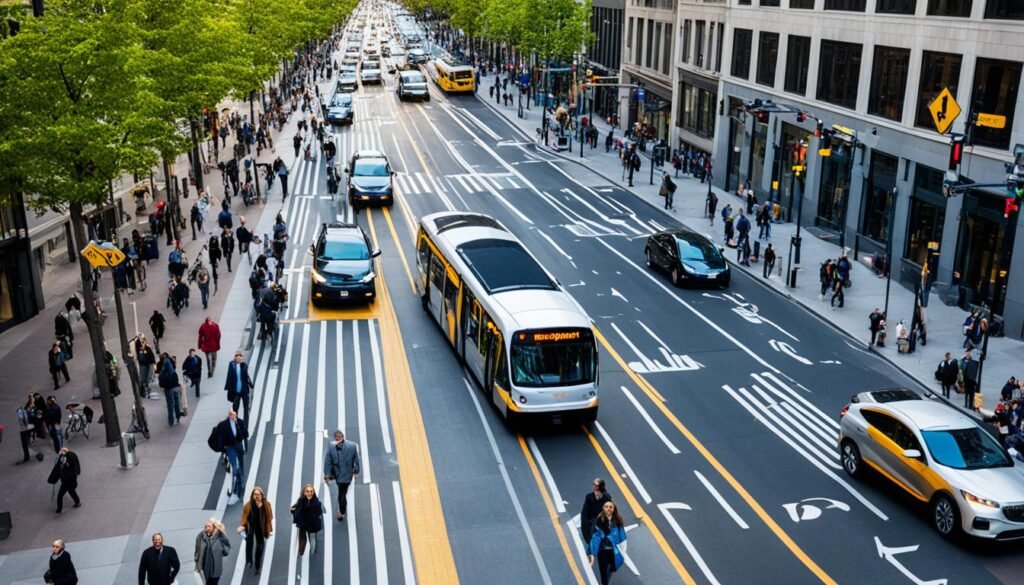
Smart city parking projects join parking with public transport. They mix smart parking integration with public transport and up-to-the-minute transit details. This mix persuades people to use public transport, cutting down on how many cars are on the streets. Users get the latest info on transit station parking management, helping them choose how to get around wisely.
Multimodal Transportation Solutions
This method backs multimodal transportation solutions and eases the jam in city centres. People can move from parking to public transport smoothly. This parking-public transit integration means better, greener ways to get around, lessening the harm from too many cars.
| Benefits of Integrated Parking and Public Transport | Key Metrics |
|---|---|
| Reduced traffic congestion | 30% decrease in vehicles circling for parking |
| Increased public transport ridership | 15% rise in transit station usage |
| Lower carbon emissions | 20% reduction in transportation-related CO2 emissions |
| Improved urban quality of life | 25% increase in resident satisfaction with local mobility |
Financial and Operational Benefits
Smart city parking changes are great for towns, saving money and working better. They make it easier for everyone to see where to park and pay. This can make more cash through better meter use and less wrongly parked cars.
Police can also do their jobs quicker, sorting out problem cars fast. They can easily spot cars in no-parking zones or without a permit. This makes the system work better, keeping parking organised without mistakes.
Increased Parking Revenue
The financial benefits of smart parking come from getting more money off fines and fees. With smart systems using sensors, cities can manage parking better. This means fewer people ignore the rules and don’t pay, bringing in more money.
This extra cash can help improve the city for everyone. Roads can get fixed, or parks made nicer, all thanks to better parking.
Efficient Law Enforcement
The operational benefits of smart parking are big, too. It helps cops find and fix parking issues fast, like cars in the wrong spots. This makes the whole parking system work smoother, making sure all parking spots are used well.
Better parking also means the city gets the right amount of money from parking. This makes things fairer for everyone using the parking spots.
Business Growth and Development
Smart parking can help local shops and offices grow. Easy, well-managed parking makes people want to visit more. So, more people come, shops sell more, and the area gets busier and better.
This brings good changes for the whole community, making the local economy stronger. More people shopping or working in the area means more life and activity.
| Benefit | Description | Impact |
|---|---|---|
| Increased Parking Revenue | Improved meter compliance and reduced parking violations | Significant boost in parking-related income for municipalities |
| Efficient Law Enforcement | Rapid identification and addressing of parking infractions | More effective and streamlined parking management system |
| Business Growth and Development | Increased accessibility and convenience for customers and employees | Thriving local economy with higher foot traffic and sales |
https://www.youtube.com/watch?v=tZfzsvDOmIw
Environmental and Sustainability Impacts
Smart city parking plans offer big benefits for our earth and future. They cut down on the car search time, which means less carbon emissions and better air quality. This makes our towns and cities nicer places to be, improving the life quality for everyone there.
Reduced Carbon Emissions
By using smart parking tech like real-time advice and varying prices, we’re doing our part for the planet. These systems guide drivers directly to open spots. This cuts down on wasted fuel and lowers carbon emissions. It’s a win for the environment and our fight against climate change.
Improved Air Quality
Smart parking also does a lot to make our air cleaner. It stops vehicles from idling or driving around needlessly, which cuts down on bad pollutants in the air. This means better air for us to breathe and a healthier city life.
Liveable Urban Spaces
But smart parking is not just about making our air and Earth better. It also helps with traffic and parking control, making our cities more liveable. This way, walking, cycling, and using public transport becomes easier and safer. It improves life in the city and makes it a more pleasant place to be.
Implementing Smart Parking Solutions
Smart parking solutions involve both the public and private sectors. Municipalities in the UK work with businesses. They install and manage high-tech parking systems. These include sensors, cameras, and data tools.
Public-Private Partnerships
Cities team up with companies to make smart parking a reality. They do this to use the private sector’s skills and resources. Together, they easily bring in new technologies. This makes parking systems work better.
Stakeholder Engagement
Working closely with groups like local businesses is key. It helps make sure smart parking works for everyone. Getting feedback and solving issues helps the community accept these solutions. This support is vital for their success.
Pilot Projects and Scalability
Starting with small projects lets cities see what works. They improve these systems bit by bit. This ensures the big change to smart parking is smooth. It also makes these solutions long-lasting.
Case Studies and Best Practices
Smart city parking efforts are picking up around the world. Many cities have become shining examples of smart parking. They are Germany, Spain, and the USA. These places have set the bar high for others to follow.
Bad Hersfeld, Germany
In Bad Hersfeld, Germany, Mayor Thomas Fehling led a big change in parking. He started a project using sensors. This project guides drivers to empty parking spaces, easing traffic jam and lowering pollution. The town also found better ways to manage parking thanks to all the data they collected.
Barcelona, Spain
Barcelona, Spain sees smart parking as key to its smart city plans. It mixes live parking data with public transport info. This makes it easy for people to move around. The city’s move boosts the quality of life there, making things smoother for everyone.
San Francisco, United States
Across the ocean, San Francisco is leading with its smart parking plan. It’s all about using smart data to set parking prices. By forecasting parking needs, the city can manage its parking better. This not only helps the city’s budget but also makes parking simpler for drivers.
Conclusion
Smart city parking initiatives use advanced tech to change how UK cities handle traffic and parking problems. They set up smart parking areas that have digital payments, help you find spaces, and gather data. This helps cut down on traffic, pollution, and makes the city better for everyone.
Cities in the UK work with both public and private groups to make smart parking work. Everyone from city officials to businesses gets involved. As more people move to cities, the need for smart and green ways to move around grows. These efforts in smart parking are key to better city life in the UK.
The end goal of smart parking is to make cities in the UK better for everyone. These new tech solutions will help people move around easier, make the air cleaner, and improve life quality. With more progress in smart parking, UK cities will deal better with traffic and become more pleasant and green places to live.
FAQ
What are smart city parking initiatives?
Smart city parking initiatives use high-tech tools to make city parking better. They help deal with traffic jams, make businesses money, and improve how parking is run in big places.
How do smart parking technologies work?
They work by checking if a parking spot is taken, using sensors or cameras. Then they send this info online. Drivers can see a real-time map of parking spots on their phones.
What are the key features of smart city parking initiatives?
These projects use smart parking tools, changing prices and how we pay, guiding drivers to spaces, and collecting parking data. They also link to public transport.
How do smart parking solutions benefit cities and their residents?
Smart parking makes money, improves jobs, and helps the planet by cutting down on pollution. It makes living in cities better for everyone.
What are the challenges in implementing smart parking solutions?
Making smart parking work needs everyone to help, like the city and local groups. They should try small projects first to make sure they work before doing them in the whole city.
What are some examples of successful smart city parking initiatives?
Places like Bad Hersfeld in Germany, Barcelona in Spain, and San Francisco in the US show how smart parking can make life in cities better. They use smart tools and data to make parking and moving around their cities easier and nicer.