



Introduction: A New Angle on the Family SUV
In a segment often defined by conservative evolution, the fifth-generation Hyundai Santa Fe arrives as a genuine revolution. It has cast aside the familiar, flowing lines of its predecessors in favour of a radical, “high-concept” aesthetic that is unapologetically bold and boxy. This is one of the most audacious redesigns in the mainstream SUV market, a vehicle that has consciously traded anonymous curves for a “boxy chic” presence that demands attention in the supermarket car park and on the school run.
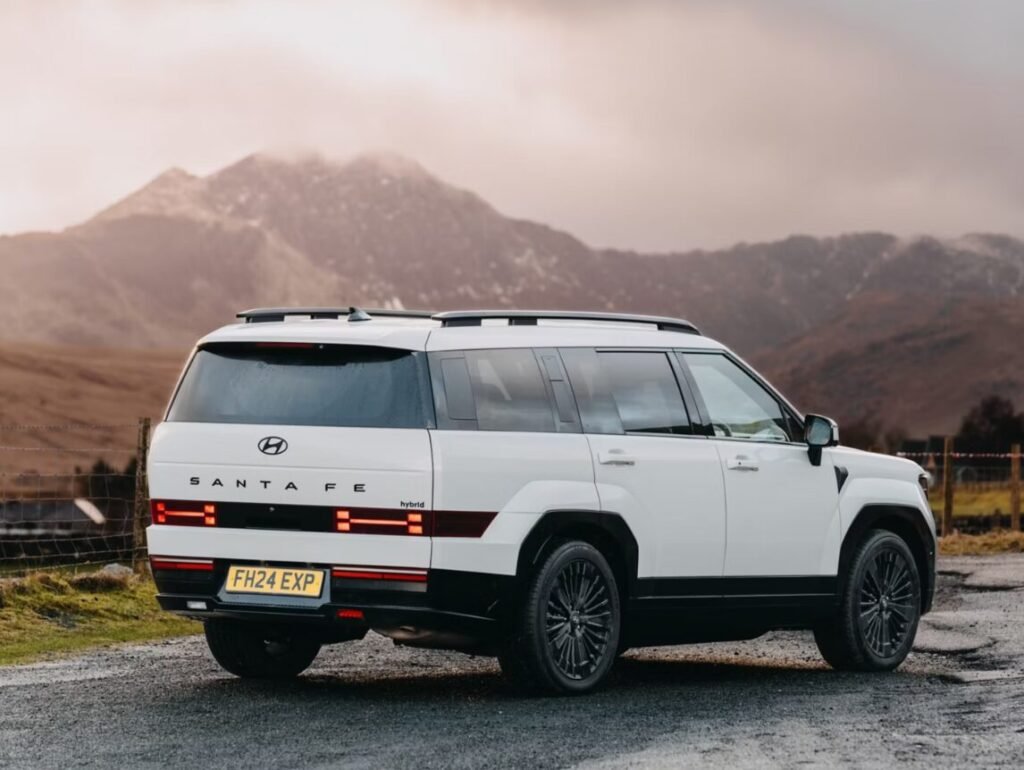
The 2025 Santa Fe enters the UK’s crowded and fiercely competitive 7-seater SUV arena not merely as another contender, but as a statement piece. It aims to fuse supreme family-focused practicality with a newfound, rugged desirability that challenges the established order. This article serves as the definitive UK guide to this transformative vehicle. It will provide a comprehensive analysis of its design philosophy, the UK-specific hybrid powertrain strategy, its ingeniously practical interior, the suite of advanced technology, and its strategic market positioning against key rivals. By also examining its impressive global launch and sales performance, this report will offer a complete and nuanced picture for any potential UK buyer considering this bold new family hauler.
Section 1: The Design Revolution: From Curve to Crate
The most striking aspect of the 2025 Santa Fe is its complete visual reinvention. Hyundai has deliberately moved away from the safe, aerodynamic styling of the previous generation and embraced a design language built on confidence, utility, and a surprising level of premium aspiration.
Exterior Analysis – A Study in Right Angles
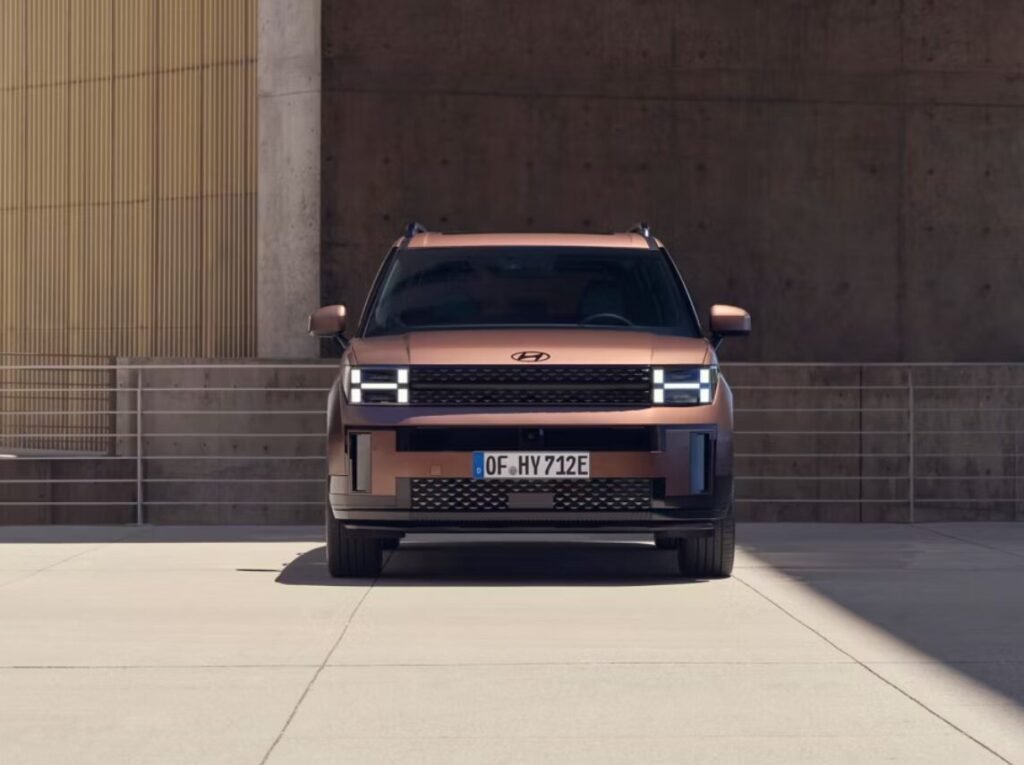
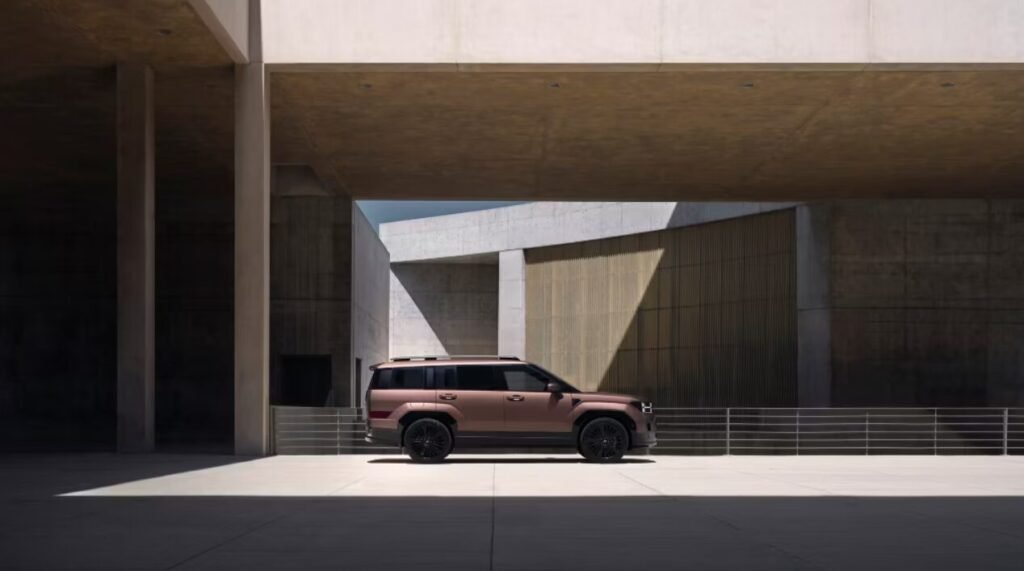
The core of the Santa Fe’s new identity is its intentional, “strong and boxy” design language. This aesthetic is a significant departure from segment norms and clearly evokes the presence of premium off-roaders like the Land Rover Defender and Discovery. This is not a coincidental resemblance; it is a calculated move to reposition the Santa Fe upmarket. By adopting a design trend popularized by prestigious brands, Hyundai is creating a powerful visual association that elevates the Santa Fe’s perceived value and desirability beyond its price point. This design-led strategy aims to make buyers feel they are acquiring a premium-looking product for mainstream money, thereby justifying its price increase over rivals like the Skoda Kodiaq and attracting customers who might be stretching for a base-model premium SUV.
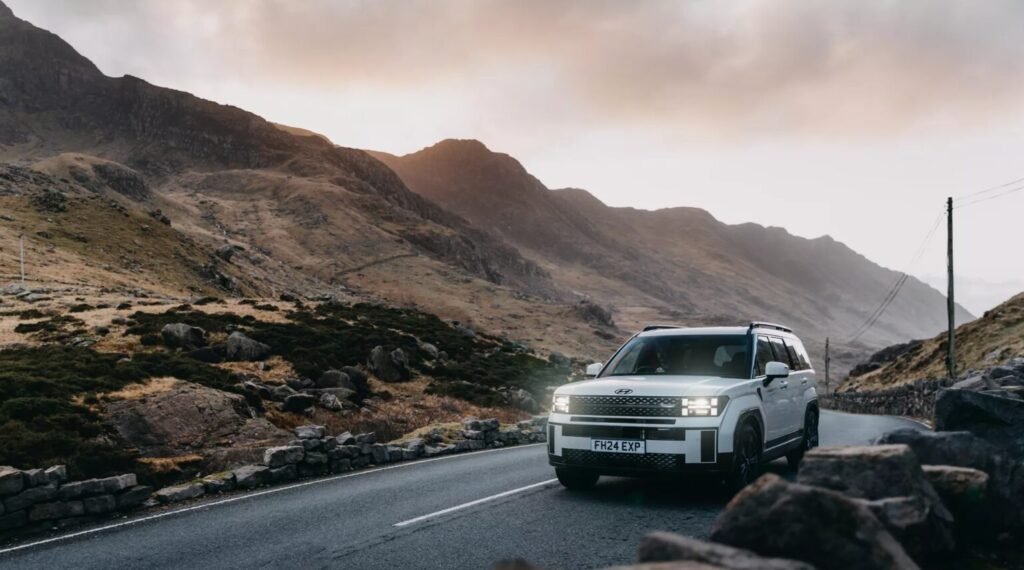
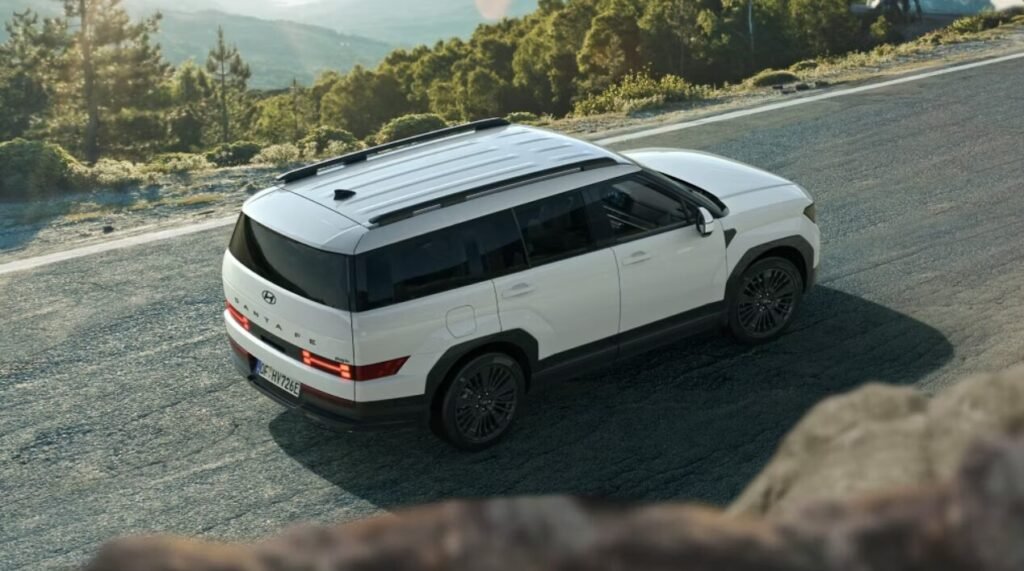
This visual strategy is reinforced by meticulous detailing. The signature “H” motif, cleverly integrated into the LED headlights and taillights, provides a unique and unmistakable visual identity, both day and night. The design is not purely for show; it incorporates highly functional elements. The enormous, wide-opening tailgate is a standout feature, creating what Hyundai calls a “terrace-like” space at the rear, perfect for outdoor activities, tailgating, or even camping. On the top-tier Calligraphy trim, a hidden C-pillar assist handle provides a practical, if quirky, handhold for accessing the standard roof rails. While the rugged XRT trim available in North America—with its all-terrain tyres and increased ground clearance—is not offered in the UK, its influence on the overall adventurous persona is clear. The rear design, noted by some owners as being less universally praised than the bold front end, is clean and functional, though its very low-set taillights and expansive flat surface remain a key talking point.
Interior Philosophy – Where Rugged Meets Refined
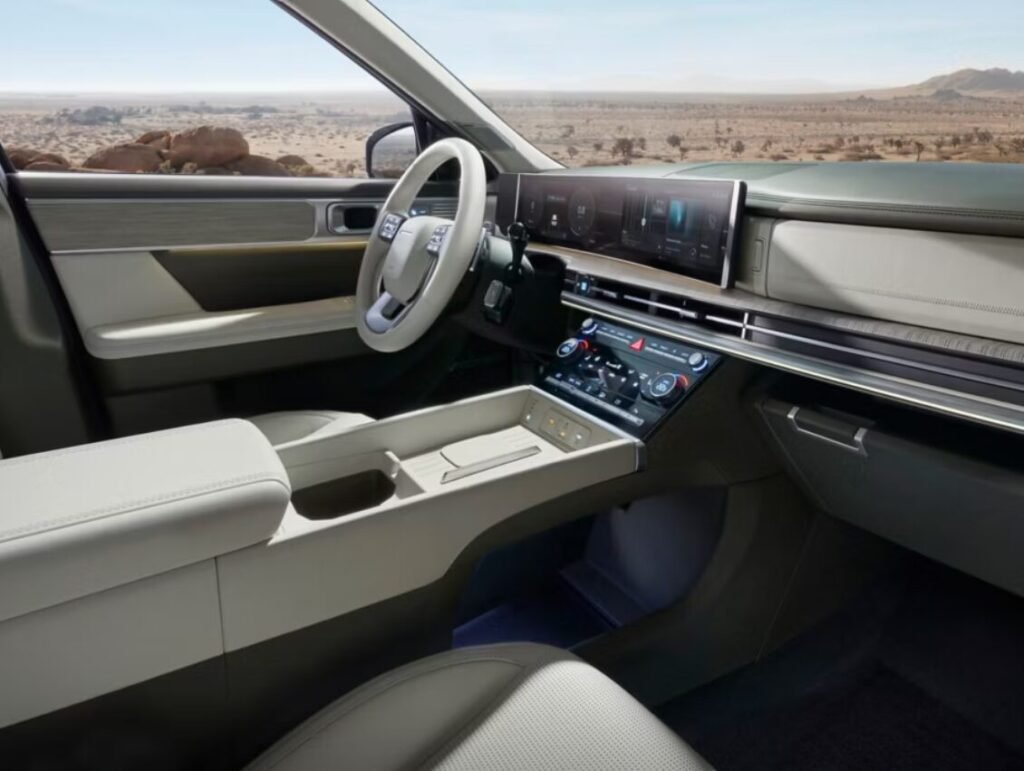
The linear, angular theme of the exterior flows seamlessly into the cabin. The interior is a masterclass in modern, practical design, with a dashboard dominated by dramatic rectangles and a strong horizontal layout that enhances the sense of space. The result is a luxurious and thoughtfully crafted environment that feels as if it could belong to a high-end British brand.
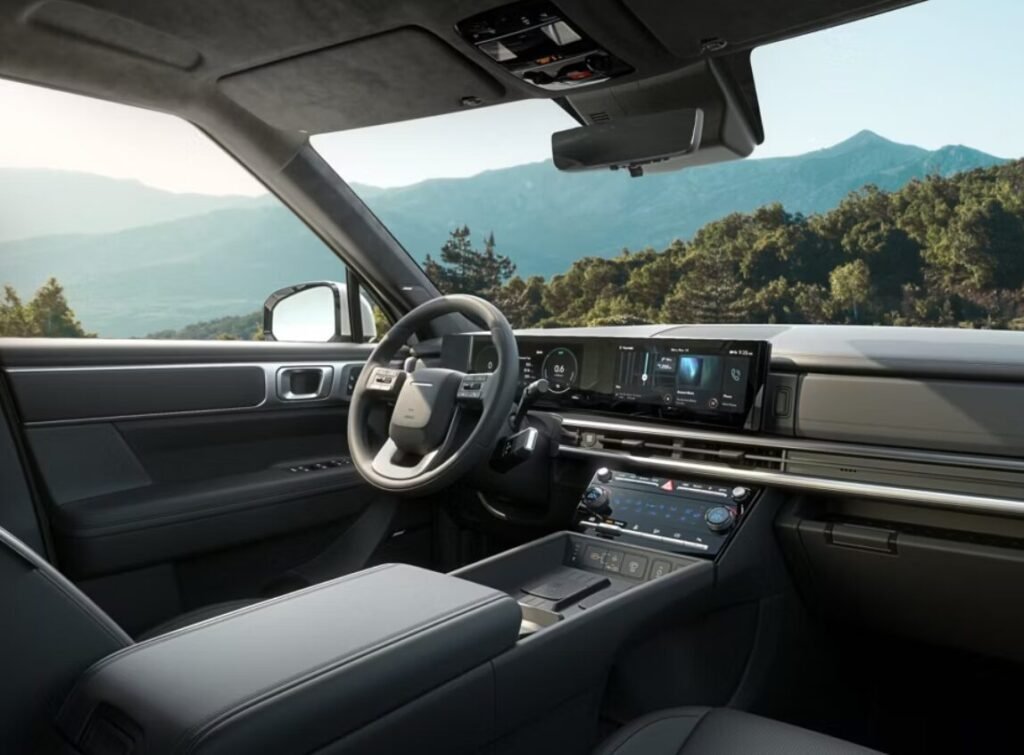
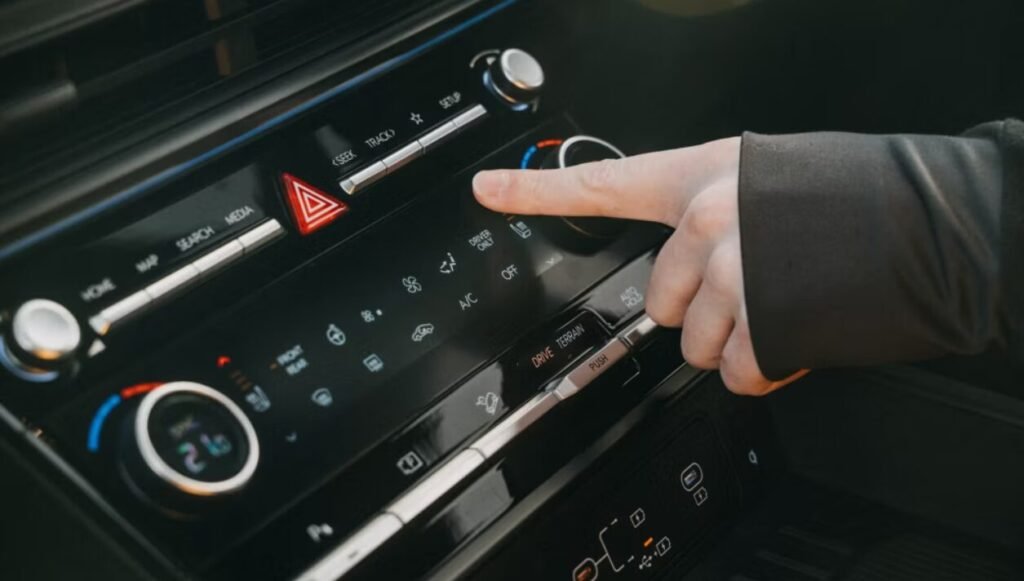
At the heart of the dashboard is a stunning panoramic curved display, which elegantly houses two 12.3-inch screens—one for the driver’s digital instruments and one for the central infotainment system. This high-tech centrepiece establishes a contemporary and premium ambiance. Crucially, Hyundai has balanced this modernity with outstanding ergonomics by retaining physical knobs and buttons for critical, frequently used functions like climate control and audio volume. This user-friendly decision has been widely praised, avoiding the driver distraction that can result from burying essential controls within touchscreen menus.
Material quality is impressive across the range, from the durable and practical YES Essentials® stain-resistant cloth on entry-level models to the supple, premium Nappa leather found on the top-tier Calligraphy trim. The cabin features a pleasant mix of soft-touch surfaces, well-textured plastics, and stylish trim elements, creating an overall impression of a well-made and durable interior built to withstand the rigours of family life.
Section 2: The UK Powertrain Portfolio: Hybrid Efficiency Takes Centre Stage
Hyundai’s powertrain strategy for the new Santa Fe highlights a clear divergence between major global markets, a decision driven largely by regional regulations and tax structures.
A Tale of Two Markets – UK’s Electrified Focus
For the UK and European markets, the 2025 Santa Fe is offered exclusively with electrified powertrains. The sole engine is a 1.6-litre turbocharged four-cylinder petrol unit, which is paired with either a self-charging full hybrid (HEV) system or a more potent plug-in hybrid (PHEV) system. This is in stark contrast to the offering in North America, where the standard engine is a powerful, non-hybrid 2.5-litre turbocharged inline-four that produces a substantial 277 hp and 311 lb-ft of torque.
This powertrain split is not a reflection of consumer preference but a direct and strategic response to the stringent emissions regulations and tax schemes prevalent in the UK and EU. Policies such as the Benefit-in-Kind (BIK) tax for company cars make large, non-electrified petrol engines prohibitively expensive for many to own and run. Consequently, the Santa Fe’s core competitive argument in the UK shifts fundamentally. It competes not on raw horsepower, as its US counterpart does, but on running costs, tax efficiency, and the practicality of its PHEV’s electric range for daily commutes. This calculated move makes the Santa Fe a far more compelling proposition for the lucrative UK company car market.
UK Performance and Economy Deep Dive
The UK-specific powertrains are tuned for a balance of efficiency and adequate performance for a large family vehicle.
- Hybrid (HEV): This version produces a combined system output of 215 PS (211 bhp) and is paired with a smooth 6-speed automatic transmission. It is available with either front-wheel drive (2WD) or HTRAC all-wheel drive (AWD). The official combined fuel economy is stated as 40.9mpg, though real-world driving is likely to yield figures in the mid-to-high 30s. Performance is leisurely rather than rapid, with a 0-62mph time of around 9.6 seconds for the 2WD model and 9.8 seconds for the AWD version.
- Plug-in Hybrid (PHEV): The PHEV variant offers a more robust total output of 253 hp (249 bhp) and comes with AWD as standard. Its key advantage is a 13.68kWh battery pack that provides an official electric-only range of up to 33.6 miles (WLTP). This capability allows for many daily journeys, such as the school run or a short commute, to be completed without using any petrol, dramatically reducing running costs. Furthermore, its low CO2 emissions make it an exceptionally attractive option for company car users, thanks to significantly lower BIK tax rates.
Driving Dynamics – The Comfort Cruiser
The on-road character of the Santa Fe is consistent with its mission as a family-friendly utility vehicle. The ride quality is consistently described as quiet, refined, and comfortable, with a suspension tune that prioritizes a soft, absorbent ride over sharp, sporty handling. It excels as a long-distance motorway cruiser, where it remains composed and serene, isolating occupants from road and wind noise effectively.
The handling is safe, predictable, and confidence-inspiring, but it is not engineered to thrill. Reviewers note it as “indifferent,” with a degree of body roll in corners, which is expected for a tall, comfort-oriented SUV. The steering is reasonably accurate and well-weighted but offers little in the way of feedback, reinforcing that the vehicle is designed for smooth, dignified progress rather than spirited driving on challenging B-roads. Under heavy acceleration, the 1.6-litre engine can sound coarse as it works to move the vehicle’s considerable mass.
Section 3: The Practicality Proposition: Space, Storage, and Family Life
Beyond its striking design, the Santa Fe’s greatest strength lies in its exceptional practicality. The interior has been meticulously designed to accommodate the complex demands of modern family life, with a focus on space, versatility, and clever storage solutions.
The Seven-Seat Standard
A core feature of the UK-market Santa Fe is its standard three-row, seven-seat configuration, making it a highly versatile people carrier.
- First Row: The front seats offer excellent long-distance comfort and a commanding view of the road. The top-spec Calligraphy trim elevates this further with “Premium Relaxation Seats,” which feature power-extending leg rests for ultimate comfort during breaks on long journeys.
- Second Row: Described as a “big sofa,” the middle row provides generous legroom of up to 42.3 inches, accommodating adults with ease. The bench slides and reclines, allowing occupants to perfectly balance their own comfort with the space required for those in the third row. For those seeking a more luxurious layout, the Calligraphy trim offers an optional six-seat configuration with individual middle-row captain’s chairs for a £1,000 premium.
- Third Row: The rearmost seats are a key differentiator. While, like most vehicles in this class, they are best suited for children or smaller adults on shorter journeys, they are more accommodating than many rivals. With 30.0 inches of legroom, the space is usable. Crucially, Hyundai has equipped the third row with its own dedicated air vents, fan speed control, and USB-C ports, ensuring passengers back there are not treated as an afterthought—a significant advantage over competitors like the Skoda Kodiaq.
Cargo and Storage – A Place for Everything
The Santa Fe’s boxy dimensions pay huge dividends when it comes to cargo capacity and interior storage.
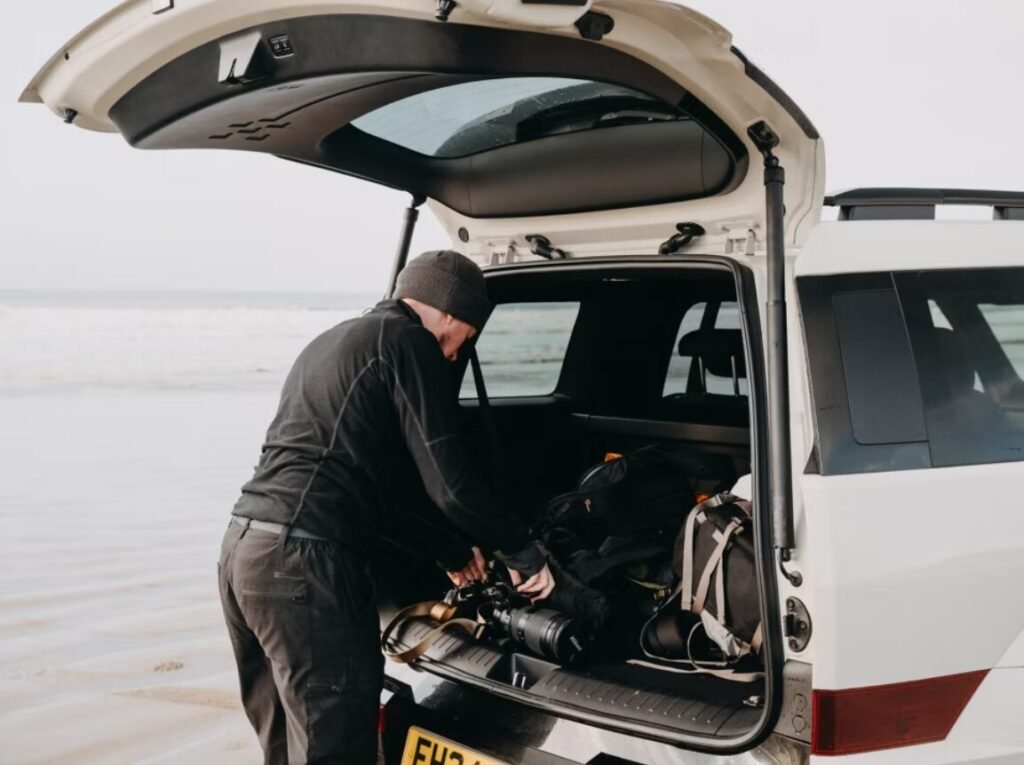
- Boot Space: The vehicle offers highly competitive and usable luggage space. With all seven seats in place, there is 14.6 cubic feet (approximately 413 litres) of space behind the third row. Folding the third row flat opens this up to a capacious 40.5 cubic feet (approximately 1,147 litres). With both the second and third rows folded, the Santa Fe transforms into a van-like hauler with a massive 79.6 cubic feet (approximately 2,254 litres) of maximum cargo capacity. The square shape and wide, low-loading tailgate make accessing and utilising this space incredibly easy.
- Cabin Storage: The cabin is a masterclass in clever packaging. It is filled with thoughtful solutions that address the real-world needs of families. Highlights include a large, open pass-through area under the floating centre console, perfectly sized for a handbag or small backpack. The main centre console storage bin features an innovative bi-directional lid, allowing it to be opened and accessed by passengers in both the front and second rows. Large cubbies line the door panels, and an abundance of cupholders are scattered throughout the cabin. Higher trims feature dual wireless charging pads that can charge two phones simultaneously. The top Calligraphy trim also includes a unique UV-C sterilisation tray hidden in the upper dashboard, allowing users to sanitise items like phones, keys, and wallets—a novel touch in a post-pandemic world.
This meticulous attention to detail reveals a design philosophy that extends beyond simply providing space. Features like the bi-directional console, integrated window blinds, and dedicated third-row amenities demonstrate that Hyundai has deeply considered how families actually use their vehicles day-to-day. This focus on solving the small, everyday frustrations of family travel creates a profound sense of user-friendliness and practicality, which serves as a key differentiator that can build significant brand loyalty.
Section 4: Technology and Safety for the Digital Age
The 2025 Santa Fe is equipped with a comprehensive suite of modern technology, covering infotainment, connectivity, and advanced driver assistance systems. This focus on technology is a core part of its value proposition.
Infotainment and Connectivity
The driver’s interface is dominated by the elegant dual 12.3-inch screens, which have been praised for their crisp graphics, quick response times, and intuitive layout. The infotainment system comes standard with wireless Apple CarPlay and Android Auto, SiriusXM satellite radio, and Hyundai’s Bluelink+ connected services, which provide features like remote start and vehicle status checks via a smartphone app. The system’s natural voice recognition is notably effective, accurately interpreting commands for navigation, audio, and climate functions.
Higher trim levels add further premium features, including a powerful 12-speaker Bose premium sound system, a Head-Up Display (HUD) that projects key information onto the windscreen, and Hyundai’s Digital Key 2, which allows the owner to use their compatible smartphone as the vehicle key.
Hyundai SmartSense Safety Suite
A comprehensive suite of Hyundai SmartSense safety and driver-assist features is included, reinforcing the Santa Fe’s family-first credentials. Standard features across all UK trims include Forward Collision-Avoidance Assist (FCA) with automated emergency braking, Smart Cruise Control with Stop & Go, and Lane Keep Assist.
Moving up the range unlocks more sophisticated systems. The Ultimate and Calligraphy trims feature Highway Driving Assist 2 (HDA 2), a semi-autonomous system that helps maintain speed, distance, and lane position on the motorway, and can even assist with lane changes. These trims also include the highly-regarded Blind-Spot View Monitor, which displays a live camera feed of the vehicle’s blind spot directly in the digital instrument cluster when the indicator is activated, providing an extra layer of confidence when changing lanes.
Parking Technologies
Given the Santa Fe’s considerable size, its available parking technologies are particularly relevant for navigating tight UK car parks and streets.
- Surround View Monitor: Available on higher trims, this 360-degree camera system provides a clear, bird’s-eye view of the vehicle’s immediate surroundings on the main infotainment screen. The view is manipulatable, allowing the driver to check for obstacles with precision, making parking in confined spaces significantly easier.
- Parking Sensors: To complement the cameras, higher trims are equipped with a comprehensive array of parking sensors on the front, rear, and sides of the vehicle, providing audible and visual warnings of nearby objects.
- Remote Smart Parking Assist (RSPA): A standout feature on top-tier models, RSPA allows the driver to stand outside the vehicle and use the key fob to remotely move the car forwards or backwards in a straight line. This is particularly useful for getting into or out of very tight parking spaces where opening the doors would be impossible. User feedback on this feature is mixed; some find it “gimmicky” as it cannot steer the vehicle around corners, while others praise its utility in tight home garages and its ability to automatically straighten itself within a parking bay.
Hyundai’s strategy of equipping the Santa Fe with advanced technologies often reserved for more expensive luxury brands is a clear example of “premium democratisation.” By offering features like the large curved display, Blind-Spot View Monitor, and RSPA, Hyundai directly challenges the notion that cutting-edge technology must come with a premium price tag. This approach is crucial to the Santa Fe’s market position, allowing it to offer a tech-laden experience that significantly undercuts comparably equipped premium rivals, making its value equation extremely compelling.
Section 5: Cracking the UK Market: Trims, Pricing, and Value
Hyundai Motor UK announced the pricing and specification for the all-new Santa Fe in April 2024, revealing a three-tier lineup that is generously equipped from the base level upwards.
UK Trim Level Breakdown
The Santa Fe is available in Premium, Ultimate, and Calligraphy trims, each offering a distinct level of luxury and technology.
| Feature Category | Premium | Ultimate | Calligraphy |
| Starting OTR Price | From £46,775 | From £50,275 | From £52,775 |
| Wheels | 20-inch Silver Alloy Wheels | 20-inch Silver Alloy Wheels | 20-inch Black Alloy Wheels |
| Exterior | Full LED Lighting, Privacy Glass, Smart Power Tailgate, Roof Rails | Dual Glass Sunroof (Tilt/Slide) | Hidden C-Pillar Assist Handle, Black Finish Styling Elements |
| Interior Seating | Leather Interior, Heated Front Seats & Steering Wheel | Driver’s Memory Seat, Heated Rear Seats | Nappa Leather Interior, Premium Relaxation Front Seats, Ventilated Front Seats |
| Audio & Infotainment | 12.3-inch Touchscreen with Navigation, Wireless Phone Charging | BOSE Premium Sound System | Head-Up Display (HUD) |
| Convenience & Tech | Dual Zone Climate Control | Electrically Adjustable Steering Column | UV-C Sterilisation Tray, Digital Rear View Mirror |
| Advanced Safety | Full SmartSense Suite (FCA, LKA, SCC) | Highway Drive Assist 2 (HDA 2), Surround View Monitor | Remote Smart Parking Assist (RSPA) |
| Seating Config. | 7-Seat Standard | 7-Seat Standard | 7-Seat Standard (6-Seat Optional for £1,000) |
The Value Proposition
The Santa Fe’s core value proposition lies in its ability to offer the space and features of a large premium SUV for the price of a smaller one. Even the entry-level Premium model, starting from £46,775, is exceptionally well-equipped with 20-inch alloys, a powered tailgate, and the full infotainment and safety suite, features that are often costly options on German premium rivals.
This high level of standard equipment across the range makes the Santa Fe a compelling financial proposition. This is further bolstered by Hyundai’s excellent five-year, unlimited mileage warranty, which provides greater long-term peace of mind than the standard three-year warranties offered by most European competitors, including Skoda, Land Rover, and Nissan.
Section 6: The Gauntlet: Sizing Up the Competition
The 2025 Santa Fe enters a packed marketplace, competing against established mainstream rivals, its own corporate sibling, and even encroaching on the territory of premium brands.
The Sibling Showdown – Santa Fe vs. Kia Sorento
The most direct rival is the Kia Sorento, with which the Santa Fe shares its fundamental platform and powertrains. However, the two vehicles have distinctly different characters.
- Design: The Santa Fe is defined by its bold, boxy, and rugged aesthetic, whereas the Sorento presents a sleeker, sportier, and more conventional SUV profile.
- Interior: The Santa Fe’s cabin is widely considered to feel more modern, airy, and spacious, with superior headroom and more usable third-row space thanks to its upright design. It also excels with more numerous and clever storage solutions. The Sorento’s interior uses darker materials to create a sportier, more driver-focused cockpit feel.
- Value: With very similar pricing and identical industry-leading warranties, the choice between the two often comes down to aesthetic preference and the Santa Fe’s slight but noticeable advantages in interior practicality and space.
The European Establishment – Santa Fe vs. Skoda Kodiaq & Nissan X-Trail
- vs. Skoda Kodiaq: The Kodiaq is a benchmark for value and practicality in the 7-seat segment. The Santa Fe commands a higher price but justifies it with a more striking design, a more premium-feeling interior, and a higher level of standard technology. In terms of space, the Kodiaq offers a larger boot with the third row folded (up to 910 litres vs. the Santa Fe’s ~630 litres in 7-seat mode), but the Santa Fe provides significantly better passenger accommodation and amenities in its third row, making it a more comfortable choice for regularly carrying more than five people.
- vs. Nissan X-Trail: The Santa Fe is positioned as a clear step up from the X-Trail. While the Nissan is a competent family SUV, the Santa Fe offers more space in all three rows, a larger and more practical boot, and a cabin that is in a different league in terms of material quality, design, and technology.
Punching Above Its Weight – Santa Fe vs. Land Rover Discovery & Volvo XC90
This is the aspirational battleground where the Santa Fe’s value becomes most apparent. It cannot match the brand prestige, ultimate luxury, or true off-road capability of a Land Rover Discovery, nor the serene Scandinavian luxury of a Volvo XC90. However, it offers a remarkably similar on-road experience in terms of comfort, interior technology, and perceived quality for a significantly lower price. As one owner aptly put it, the Santa Fe provides “everything the more premium brands offered as standard but at a fraction of the cost”. This ability to deliver a near-premium experience without the premium price tag is its key strategic advantage.
| Model Comparison | Hyundai Santa Fe Calligraphy | Kia Sorento ‘4’ | Skoda Kodiaq SportLine | Land Rover Discovery ‘S’ | Volvo XC90 Plus |
| Starting OTR Price | ~£57,745 | ~£57,135 | ~£53,690 | ~£62,275 | ~£65,450 |
| Powertrain Type | PHEV AWD | PHEV AWD | PHEV FWD | Mild-Hybrid Diesel AWD | Mild-Hybrid Petrol AWD |
| Power (bhp) | 249 | ~261 | 204 | 249 | 250 |
| Boot (3rd row up) | ~413 litres | ~175 litres | 340 litres | 258 litres | 302 litres |
| Boot (3rd row down) | ~1147 litres | ~809 litres | 845 litres | 1,137 litres | 680 litres |
| Key Advantage | Striking design, premium tech, best 3rd row | 7-year warranty, sleek styling | Huge boot (5-seat mode), clever features | Unmatched off-road ability, brand prestige | Supreme comfort, minimalist luxury |
Section 7: A Global Success Story: The Santa Fe Beyond British Borders
The strong initial reception of the Santa Fe in the UK is backed by a highly successful launch in other key international markets, particularly North America, which serves as a powerful indicator of the model’s broad appeal.
The North American Launchpad
The fifth-generation Santa Fe was developed with a global audience in mind but had a strong focus on the North American market, where it launched first and is currently built for that region at Hyundai’s plant in Montgomery, Alabama. The market positioning there is slightly different, with the lineup headlined by the powerful 2.5-litre turbocharged petrol engine, appealing to a consumer base that often prioritizes performance. The rugged, off-road-styled XRT trim is also a key part of the US lineup, further emphasizing the vehicle’s adventurous image.
Sales Success as a Leading Indicator
Since its launch, the redesigned Santa Fe has been a remarkable commercial success in the highly competitive US market. Hyundai has reported multiple record-breaking sales months for the “Santa Fe family,” with significant year-over-year growth. In July 2025, total sales for the Santa Fe lineup surged by 57% compared to the previous year, contributing to a year-to-date increase of 21%. Similarly, sales in Q2 2025 were up 10% year-over-year.
This strong sales performance in one of the world’s most demanding SUV markets serves as a compelling proof-of-concept for the vehicle’s potential in the UK. It demonstrates that the core product—its radical design, immense practicality, and advanced technology—is not just a niche experiment but a formula that resonates powerfully with a broad base of consumers. This success de-risks the UK launch, offering reassurance to buyers who might be hesitant about the bold styling or Hyundai’s confident move upmarket. The Santa Fe arrives on British shores not as an unknown quantity, but as a globally validated and commercially successful product.
Conclusion: The Verdict on Hyundai’s Bold New Family Hauler
The 2025 Hyundai Santa Fe is a triumphant and audacious reinvention of the family SUV. It has successfully transformed from a competent but unremarkable contender into a true segment leader that commands attention. Its winning formula is a masterful blend of statement-making design, an immensely practical and high-tech interior that caters brilliantly to the chaos of family life, a comfortable and refined ride, and an outstanding value proposition that challenges both mainstream and premium rivals.
However, the package is not without its compromises. The driving experience is safe and predictable but entirely uninspired, making it a poor choice for the keen driver who values dynamic engagement. Despite being one of the best in its class, the third row remains best for occasional adult use , and the 1.6-litre hybrid powertrain can sound strained under heavy load.
Ultimately, for the target UK buyer, these are minor concessions in an otherwise brilliantly executed vehicle. For families seeking the maximum possible space, technology, style, and practicality for their money, the 2025 Santa Fe is a resounding success. By prioritising on-road comfort and real-world usability over outright performance, Hyundai has confidently established its flagship SUV as not just a compelling alternative, but arguably the new benchmark in the large family SUV market today.
